
Summary
The Sheriff Burn is a small tributary of the River Don running through the village of Kintore in Aberdeenshire. A small infestation of Japanese knotweed was identified on the burn which had the potential to spread further downstream to the River Don.
The Scottish Invasive Species Initiative, in partnership with the River Dee Trust, managed control work at the site from 2018 to 2025. This work has successfully reduced the scale and extent of the infestation. We believe we are close to eradication of Japanese knotweed on the site and responsibility for ongoing management has been handed over to the landowner.
1. Site description
The Sheriff Burn has a small, isolated section of Japanese knotweed present on the right bank of the burn, a tributary of the River Don. The site is located next to a car park of a business park near the A96, south of the town of Kintore in Aberdeenshire, which is immediately adjacent to the burn.
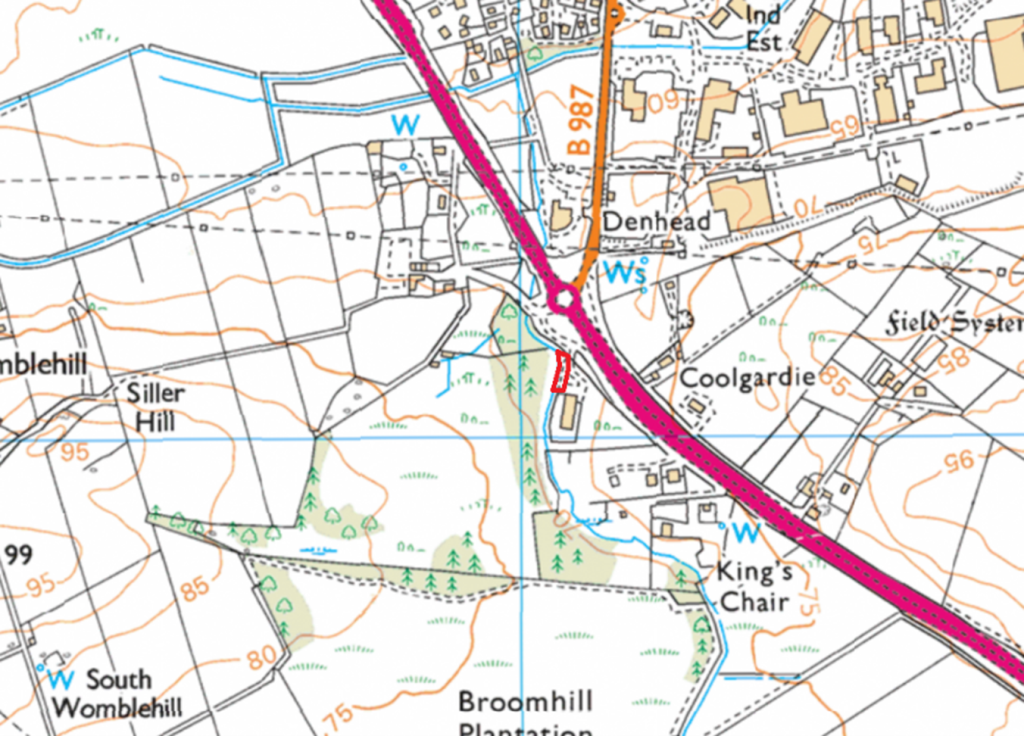
The small site, around 50m in length (grid reference NJ 7906 1412), is owned by Precision Oil Tools Ltd. The site location is shown in Map 1.
Within the Scottish Invasive Species Initiative partnership the River Don catchment is covered by the River Dee Trust.
Map 1: Location of Japanese knotweed on the Sheriff Burn – a tributary of the River Don in Aberdeenshire
2. Background
In 2011 the River Don Trust, assisted by volunteers and the Don DSFB, undertook a programme of invasive plant control supported by the Water Environment Fund – a fund managed by the Scottish Environment Protection Agency.
This programme supported the survey and mapping of invasive non-native plant species in the Don catchment and created a pool of trained volunteers who were able to support local plant control. Although local control was delivered successfully until 2013, overall progress across the catchment was slow due to the extensive and dense invasive plant stands identified.
This previous programme identified presence of Japanese knotweed on the Sheriff Burn site which, following discussion with the owner, became an active control site in 2018 as part of the Scottish Invasive Species Initiative.
This site is the only known Japanese knotweed present on the Sheriff Burn. The knotweed stand was outcompeting native flora and posed a risk of further spread – both on site and further downstream onto the River Don.
3. Management works
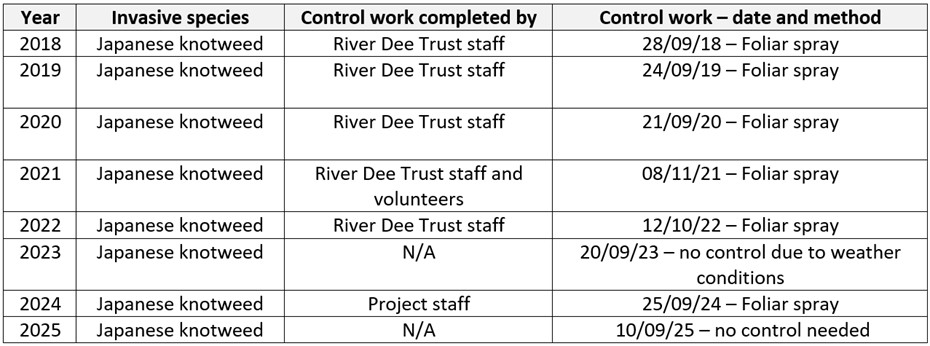
The Japanese knotweed stand on the Sheriff Burn was first treated in 2018 with annual follow up treatments through to 2022. Treatment could not take place in 2023 due to weather conditions. Since then, control work has proceeded on a biennial basis.
The stand was treated using glyphosate (RoundUp ProVantage) applied as a foliar spray (spraying directly onto the leaves of the plant) by backpack sprayer. Spraying took place at the time of flowering, in late September to early November.
A summary of the control treatments is presented in Table 1 (below).
Table 1 – Summary of Japanese knotweed control on the Sheriff Burn, River Don
4. Results
4.1 Invasive species abundance
Due to the small scale of the Sheriff Burn site, Japanese knotweed abundance was recorded at a single monitoring point (grid reference NJ 7906 1412).
The abundance of Japanese knotweed was measured using the DAFOR* scale and is shown in Table 2 below.
The extent and abundance of Japanese knotweed on the Sheriff Burn remained unchanged over control years 2018-2020, with the plant recorded as ’dominant’. Due to the size of the stand and limited accessibility on the steep banking, the entire stand could not be fully controlled in the first two years. Treatment targeted peripheral and edge plants and worked from the outside of the patch to the inside, controlling the perimeter without being able to treat the plants in the centre of the stand.
In 2020 the extent of the patch was reduced enough that the entire stand could be treated for the first time, leading to reduced abundance of Japanese knotweed in the following years. Japanese knotweed abundance was recorded as ‘frequent’ in 2021, ‘occasional’ from 2022 – 2023 and ‘rare’ from 2024 – 2025.
Table 2 – Annual Japanese knotweed abundance from surveys (2018 – 2025) on the Sheriff Burn, River Don

* – DAFOR Scale of abundance – D = Dominant (50 – 100% cover), A = Abundant (30 – 50% cover), F = Frequent (15 – 30% cover), O = Occasional (5 – 15 % cover), R = Rare (<5% cover), N = Not Present
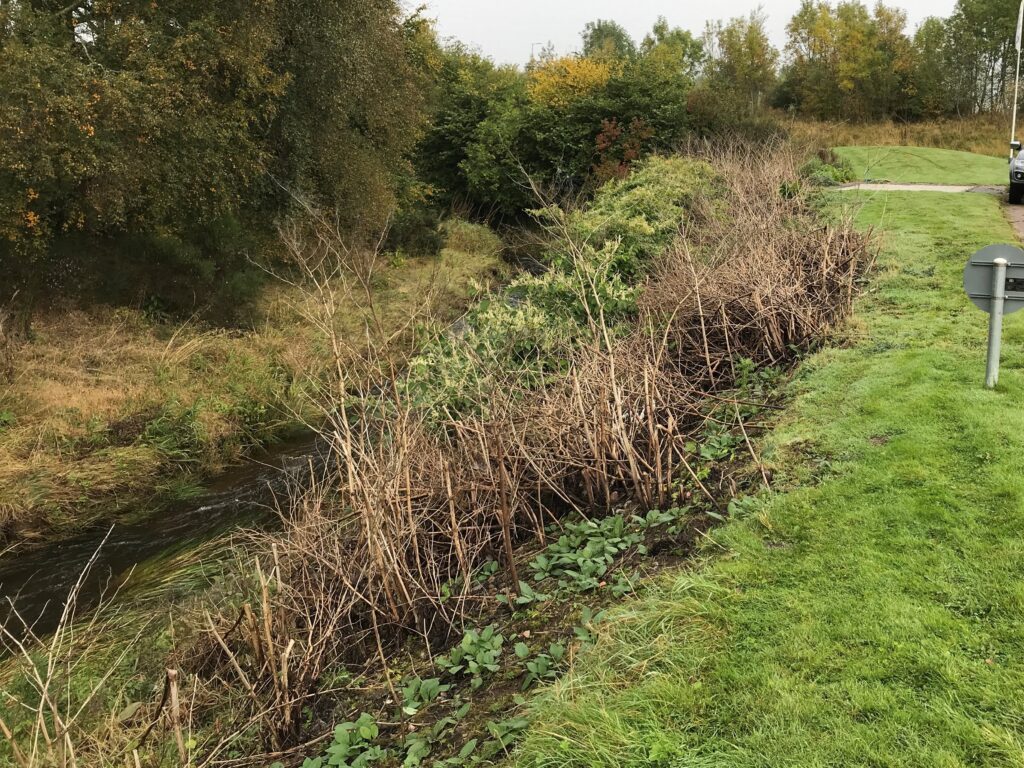
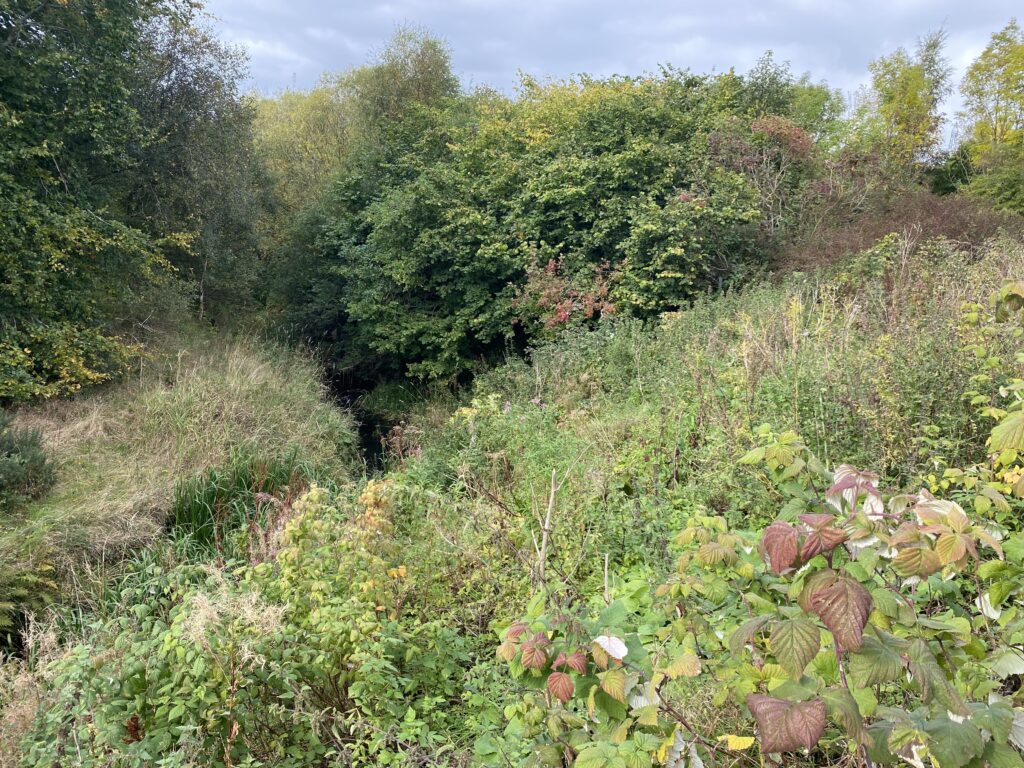
Images Before and After Control
Figure 1: Japanese knotweed on the Sheriff Burn
4.2 Chemical usage
Chemical use was recorded on an annual basis at the site. Glyphosate (RoundUp Provantage) was applied as a foliar spray at a concentration of 20ml per litre.
Table 3 (below) shows the total volume of glyphosate used in each control year.
Table 3 – Volume of glyphosate used to control Japanese knotweed (2018 – 2025) on Sheriff Burn, River Don

4.3 People effort
Control work was undertaken by staff from the River Dee Trust and the Scottish Invasive Species Initiative until 2024, with volunteer support in 2021. In 2025, the site was handed over to the landowners for ongoing management, but no control was required in this year.
Table 4 (below) shows effort in terms of hours of control work per year at the site. The consistently low time allocations reflect the small and localised nature of the infestation.
Table 4 – People hours used to control Japanese knotweed (2018 – 2025) on Sheriff Burn, River Don

5. Conclusions and Progress Made
Control measures taken on the Sheriff Burn since 2018 have reduced the abundance of Japanese knotweed on site and the time and chemical volume required for annual control.
A reduction in Japanese knotweed abundance at the monitoring point was first observed in 2021. Initially, in the first two seasons, treatment targeted peripheral and edge stems and worked from the outside of the patch to the inside, controlling the perimeter without treating the plants in the centre of the stand. This was due to the size of the plants and the density of the stand, which limited access in the first year of control. As such, the stand was not fully treated until 2020. This sequential approach delayed the anticipated reduction in Japanese knotweed abundance at the site. In 2021, there was a significant reduction in the abundance (see Table 2) from ‘dominant’ in 2020 to ‘frequent’. This reduction continued in the following years, with Japanese knotweed recorded as ‘occasional’ from 2022 – 2023 and ‘rare’ from 2024 – 2025.
The volume of chemical (see Table 3) required to control the site has decreased steadily since 2020. The first two years of spraying used low volumes of chemical as only the periphery of the stand could be reached. By 2020, the stand was more accessible and could be fully treated – the chemical volume therefore increased. Since then, the chemical volume has reduced each year control work was carried out. There was a 90% decrease in the volume of chemical required for effective treatment from 2020 to 2024 and no treatment was required in 2025.
The time needed to control the site (see Table 4) increased between 2018 and 2019 but has decreased steadily since then. Hours required for effective control decreased by 50% between 2020 (the first year the site was fully controlled) and 2024. There has been encouraging recolonisation of native plants on site with only small Japanese knotweed stems showing among these. By 2025, the patch now consists of only very small shoots that were considered too small for chemical control. The site has now been moved to a biennial monitoring and control regime.
6. Next Steps
Control of remaining and emerging Japanese knotweed regrowth will be carried out by the landowners from 2026 with support from the Scottish Invasive Species Initiative where required.
Eradication of Japanese knotweed from the current Sheriff Burn site is within reach. Control will continue on a biennial, then triennial, basis until the plant shows no further regrowth and eradication is confirmed.
Further information
Contact: sisi@nature.scot