
Summary
The Ravenscraig to Inverugie Bridge site on the mainstem of the River Ugie was the site of an established stand of Japanese knotweed, which was outcompeting native flora and increasing the likelihood of bank erosion and bank collapse. Control work was needed to tackle this issue and prevent further spread downstream.
Working with volunteers, the Scottish Invasive Species Initiative managed Japanese knotweed control at the site from 2019-2025. This work appears to have eradicated the stand of Japanese knotweed, with no knotweed found on site since 2020. The site will now be moved to a biennial monitoring programme.
1. Site description
The Ravenscraig Castle to Inverugie Bridge site is in the lower course of the River Ugie and is approximately 1.1km long. Inverugie Bridge is approximately 3.3km upstream of the mouth of the River Ugie in the coastal town of Peterhead, where the Ugie flows into the North Sea. Land use is predominately arable farmland with riparian woodland on the left bank.
Map 1 – Location of Japanese knotweed site between Ravenscraig Castle and Inverugie Bridge, River Ugie
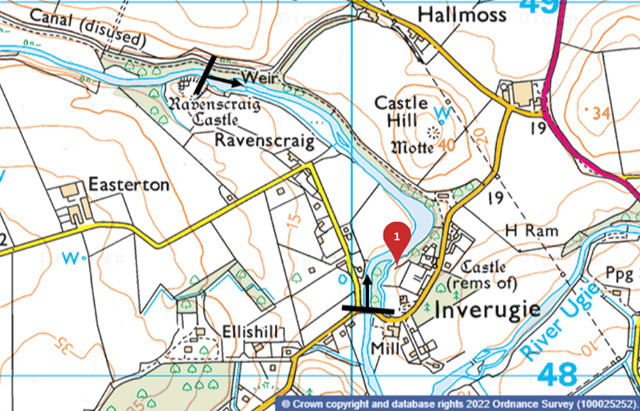
The upper limit of the site starts at Ravenscraig Castle (grid reference: NK 09604 48814) and ends at Inverugie Bridge (grid reference: NK 10047 48176) (see Map 1). Ownership is shared between several individuals including two major landowners – all of whom gave permission for project staff and volunteers to carry out control on their land.
Within the Scottish Invasive Species Initiative partnership, the Ugie catchment is covered by the Deveron, Bogie and Isla Rivers Charitable Trust.
2. Background
This section of the River Ugie was identified for control by the Scottish Invasive Species Initiative during surveys in 2018. When first identified, a dense stand of Japanese knotweed was found in one area – the stand was outcompeting native flora and posed a risk of further spread on site and further downstream.
Once the Scottish Invasive Species Initiative alerted the major landowners to the Japanese knotweed problem, both were supportive of control taking place. Project officers and volunteers carried out control on the site.
3. Management works
Japanese knotweed was first treated in 2019 with a follow up treatment in 2020. By 2021, no Japanese knotweed was detected on site but annual monitoring has continued to 2025.
Stem injection and spraying were used to treat the Japanese knotweed. Table 1 below shows a summary of the control treatments.
Table 1 – Summary of control treatments at Ravenscraig to Inverugie Bridge, River Ugie (2019 – 2020)

4. Results
4.1 Invasive species abundance
Monitoring was undertaken at one point – at the single knotweed stand – on the site from 2019 to 2025. The abundance of Japanese knotweed was measured using the DAFOR scale*. Recorded abundance is shown in Table 2 below.
Before control of Japanese knotweed began in 2019, there were no plants visible on the right bank and an ‘abundant’ stand on the left bank. Control work in 2019 and 2020 reduced the abundance of Japanese knotweed from ‘abundant’ to ‘rare’ in 2020, with no regrowth observed in 2021 and subsequent years. This is shown by the recorded abundances in Table 2.
Table 2 – Annual Japanese knotweed abundance from surveys (2019 – 2025) at Ravenscraig Castle to Inverugie Bridge, River Ugie. Only one knotweed stand was present at the site.

* – DAFOR Scale of abundance – D = Dominant (50 – 100% cover), A = Abundant (30 – 50% cover), F = Frequent (15 – 30% cover), O = Occasional (5 – 15 % cover), R = Rare (<5% cover), N = Not Present (0%)
Images before and after control
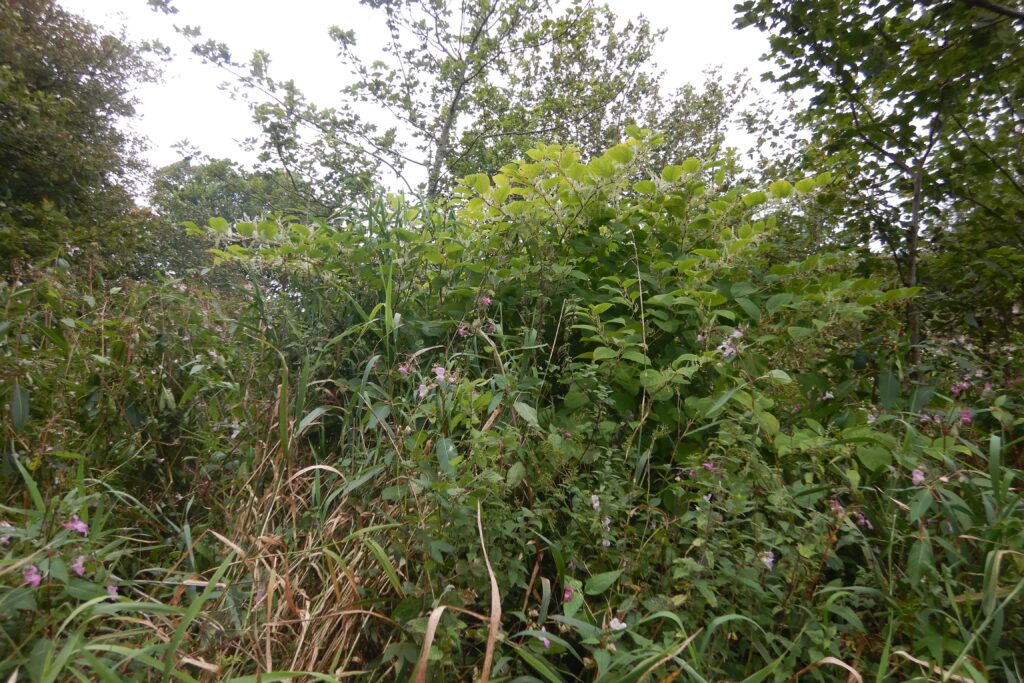
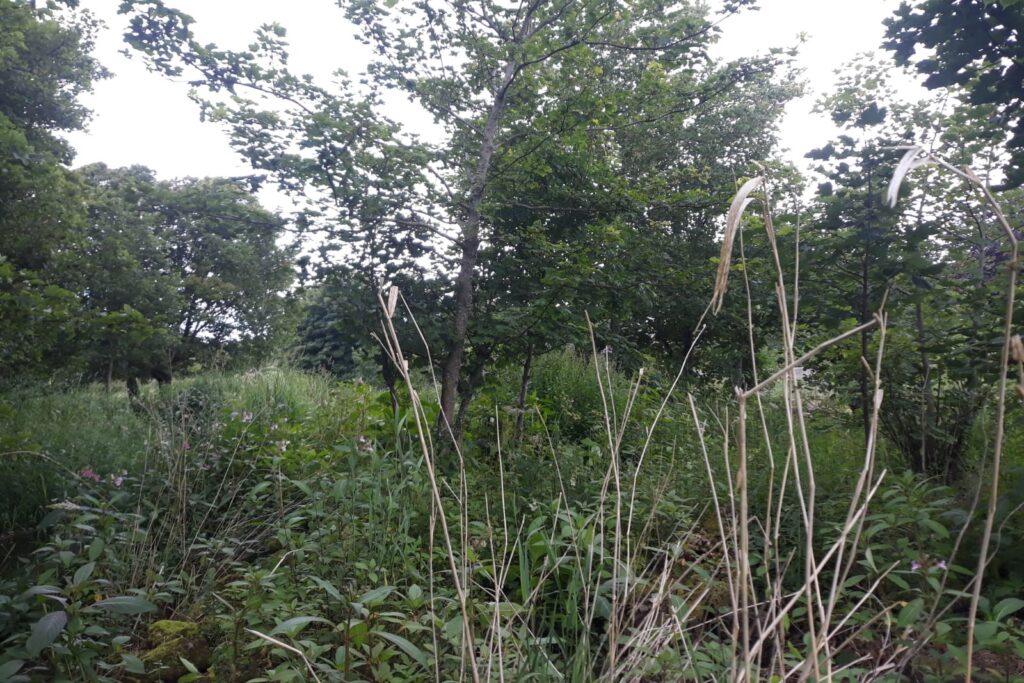
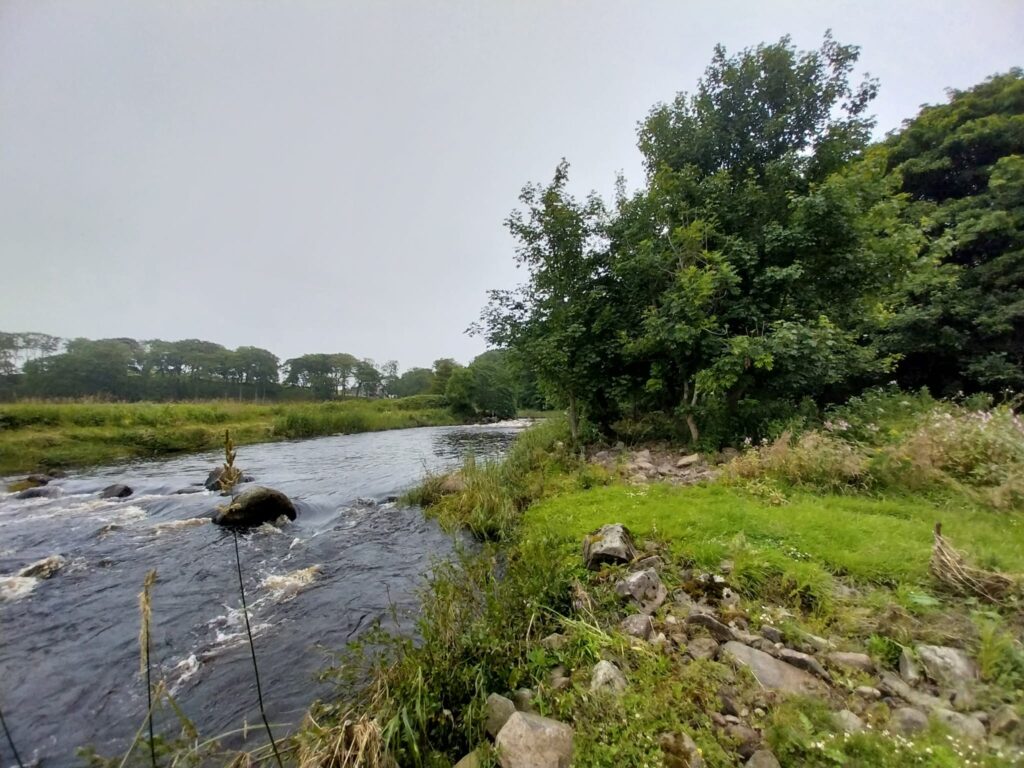
Figure 1: Japanese knotweed at Ravenscraig Castle to Inverugie Bridge, River Ugie. Figures correspond to monitoring point ‘left bank 1a’.
4.2 Chemical usage
In the first year of Japanese knotweed treatment, glyphosate (RoundUp Provantage 480mg/l) was applied by stem injector (2ml neat per stem) and in 2020 by foliar application using a knapsack sprayer (concentration of 20ml per litre). The volume of glyphosate used per year is shown in Table 3 below.
Table 3 – Volume of glyphosate used to control Japanese knotweed (2019 – 2025) at Ravenscraig Castle to Inverugie Bridge, River Ugie (2019 – 2025)

4.3 People effort
Control work was carried out by landowners and by Scottish Invasive Species Initiative staff and volunteers. Table 4 (below) shows the people hours required to control Japanese knotweed by year.
Japanese knotweed was discovered at the site in 2019. Control was undertaken in that year and 2020 but no further plants were detected from 2021 to 2025. Therefore, no control work was needed after 2020. As there was a single stand of knotweed, which was rapidly diminished and eradicated, there has been no need to hand over control of the site to landowners.
Table 4 – People hours used to control Japanese knotweed (2019 – 2025) at Ravenscraig Castle to Inverugie Bridge River Ugie (2019 – 2025)

5. Conclusions and Progress Made
Control measures taken between Ravenscraig Castle and Inverugie Bridge on the River Ugie since 2019 have eradicated Japanese knotweed from the site.
A significant reduction in the abundance of Japanese knotweed was observed at the monitoring point between 2019 and 2021 (see Table 3 and Figures 2a and 2b). The plant was recorded as ‘abundant’ in 2019, ‘rare’ in 2020 and ‘none present’ from 2021 to 2025.
Time required for Japanese knotweed control remained unchanged from 2019 to 2020 – this reflects the core time necessary to visit the site and infestation. However, there was an 80% decrease in the volume of chemical required for effective treatment from 2019 to 2020 (see Table 4). No treatment has been required since 2021.
There has been encouraging recolonisation of native flora where the Japanese knotweed was once present. As annual checks for Japanese knotweed presence are no longer required the site will be moved to a biennial, and then triennial, monitoring programme for a number of years to ensure there is no regrowth.
6. Next Steps
As there has been no sign of Japanese knotweed growth from 2021 – 2025, it is unlikely that there are viable rhizome fragments remaining in the soil. Based on annual surveys since 2021, Japanese knotweed has been eradicated from the site. The site will be moved to a biennial, and then triennial, monitoring programme for a number of years to ensure there is no further growth.
Further information
Contact: sisi@nature.scot