
Summary
Japanese knotweed has been well established on the River Lossie for many years. The Mayne Farm site is a 1.2km long single bank section of river, south of Elgin, which had a dominant and extensive knotweed infestation present. The infestation had worsened following dredging work which left large areas of bare ground, providing a perfect habitat for Japanese knotweed to colonise.
This site was first controlled by the Initiative in 2023, as part of the project’s management strategy to systematically extend control downstream as upstream sites improved. At that time, the extensive infestation blocked access to the river and Japanese knotweed was the dominant plant species present. Despite the site being relatively narrow, the combination of dense knotweed stands, steep river banks and water depth meant that safe access to carry out effective control using traditional methods would have been difficult. However, using a power spray tank, Scottish Invasive Species Initiative and partner staff and volunteers have successfully brought the infestation under control in a relatively short period of time.
1. Site description
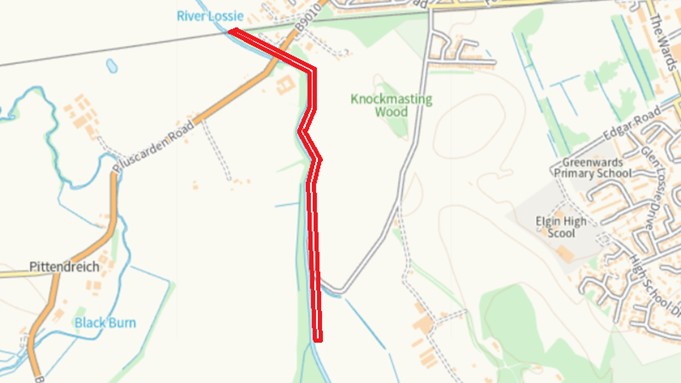
The Mayne Farm site is situated on the River Lossie, south of the town of Elgin in Moray (grid reference NJ 202 616). The control area, on the right bank of the river, extends to approximately 2.1ha, is approximately 1.2km long andis between 20-40m wide. It is accessed via an unpaved farm track, which runs down to the river near the upstream end of the site. Most of the site is owned by Mayne Farm, with some smaller downstream sections owned by private individuals. The site location is shown in Map 1.
Map 1 – Location of the Mayne Farm Japanese knotweed control site on the River Lossie
Within the Scottish Invasive Species Initiative, the Lossie catchment is covered by the Findhorn Nairn and Lossie Rivers Trust.
The site comprises of a narrow strip of river bank between field edges and the river itself. The area has been extensively modified over the years, with the main channel having recently been dredged when invasive plant control began. There is an earthen bund separating the field from the river bank. On the river side of the bund there is a track which is commonly used by dog-walkers, runners, and cyclists from nearby Elgin. There are few trees on the site, however since the dredging work took place there has been some regeneration of alder and other riparian species. As a result of the dredging, the river bank is high and steep, and the river is deep along most of the stretch highlighted in Map 1.
2. Background
The River Lossie rises in the hills above Dallas in Moray, flows north through the town of Elgin and drains into Spey Bay at Lossiemouth. Land use in the catchment is dominated by agriculture and forestry, with large stretches of the river heavily modified. Japanese knotweed was identified as a problem on the Mayne Farm site when the Scottish Invasive Species Initiative first began in 2018. This species is well established in the Lossie catchment, with infestations starting upstream at Kellas Estate – control works begin here and end at the Palmerscross bridge. The site at Mayne Farm is at the very downstream end of the project’s current control area. This site was brought into the control programme in 2023, as part of the project’s wider management strategy to extend control works further downstream as upstream locations improve.
Although Japanese knotweed was already well established on the River Lossie and on the Mayne Farm site, following dredging work carried out on this stretch of river extensive areas of bare ground were left behind. These provided perfect habitat for Japanese knotweed to recolonise – the plant re-established itself more quickly than native species and became the dominant species at the site. As a result, there was minimal regeneration of native riparian species, which affected the stability of the river bank following the dredging. The dominance of knotweed on the site also affected the public’s ability to access and enjoy a well-used riverside path and posed a biosecurity risk. With so many people using the site, the risk that Japanese knotweed would be inadvertently transferred to a new location was high, in addition to the risk of downstream movement of plant materials from banksides.
The site was first controlled by the Initiative in 2023. Prior to that, there had been some sporadic control carried out by landowners. The Initiative had controlled giant hogweed on the site prior to this, but the effectiveness of this control was hindered by the extensive Japanese knotweed infestation, which made accessing giant hogweed plants difficult. Since the site has been brought under management of the project, we have received continued support from the landowners who have provided equipment to support the work and undertaken stem clearance in the winter months. One private individual who owns one of the smaller sections of the site (hereafter referred to as a private landowner) has also helped with control work across the whole section.
3. Management works
The Japanese knotweed on the site was first treated by the Scottish Invasive Species Initiative in October of 2023.
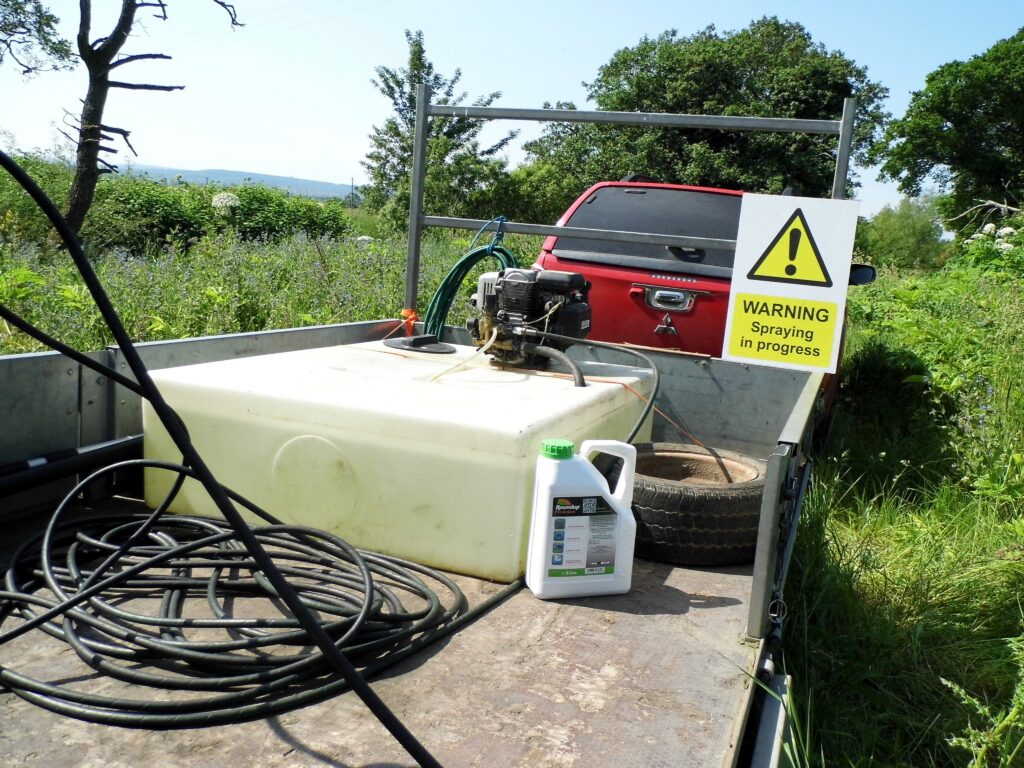
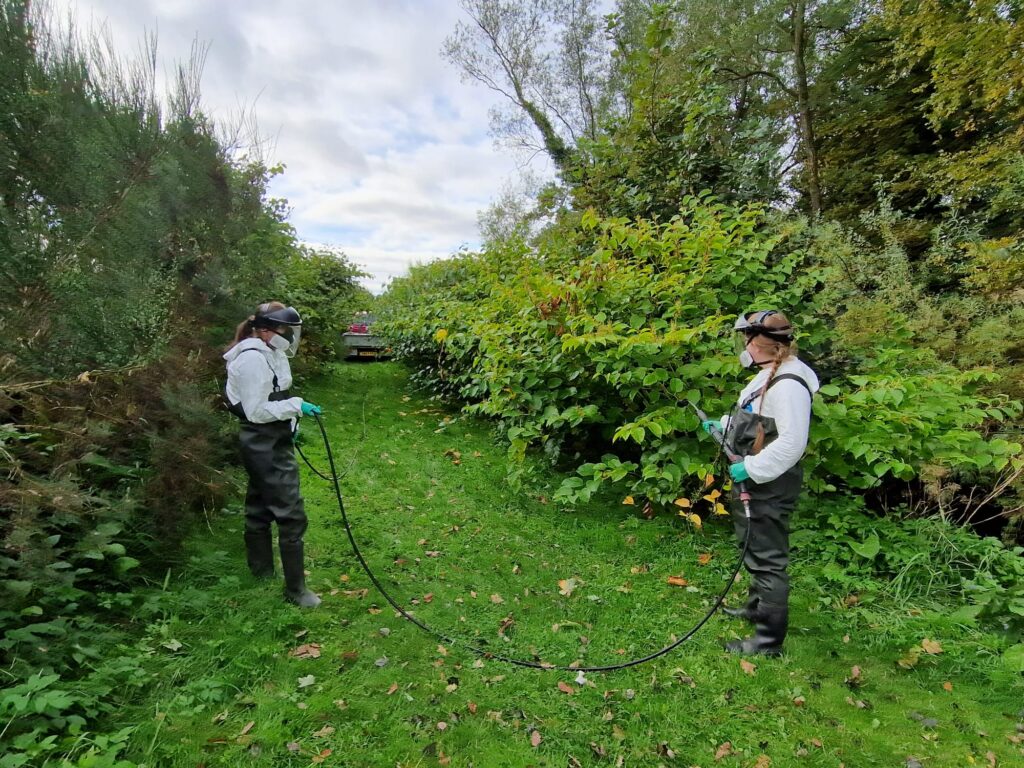
Due to the scale of infestation a power spray tank was used to significantly reduce the time required to complete control. In 2023, the majority of the infestation was treated using the power sprayer with traditional knapsack sprayers used to treat smaller patches of growth. The power sprayer is shown in Figures 1a and 1b below.
Control in 2023 significantly reduced the extent of the infestation at the site. The power sprayer was therefore not required from 2024 onwards; control in 2024 and 2025 was completed using knapsack sprayers.
Table 1 below shows a summary of the control treatments.
Table 1 – Summary of control treatments
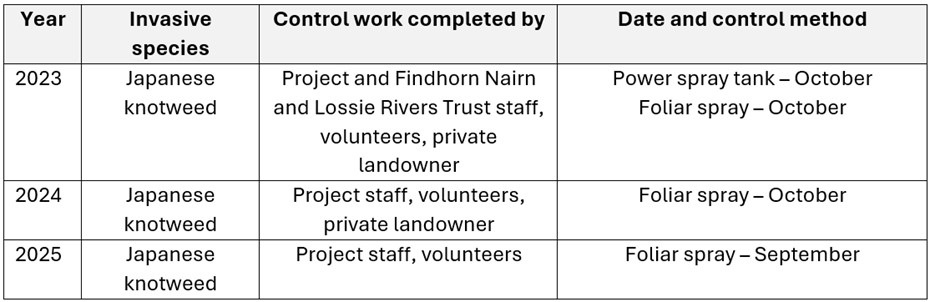
Figure 1 – a power sprayer was used in the first year of treatment to effectively and efficiently treat the vast stands of Japanese knotweed.
4. Results
4.1 Invasive species abundance
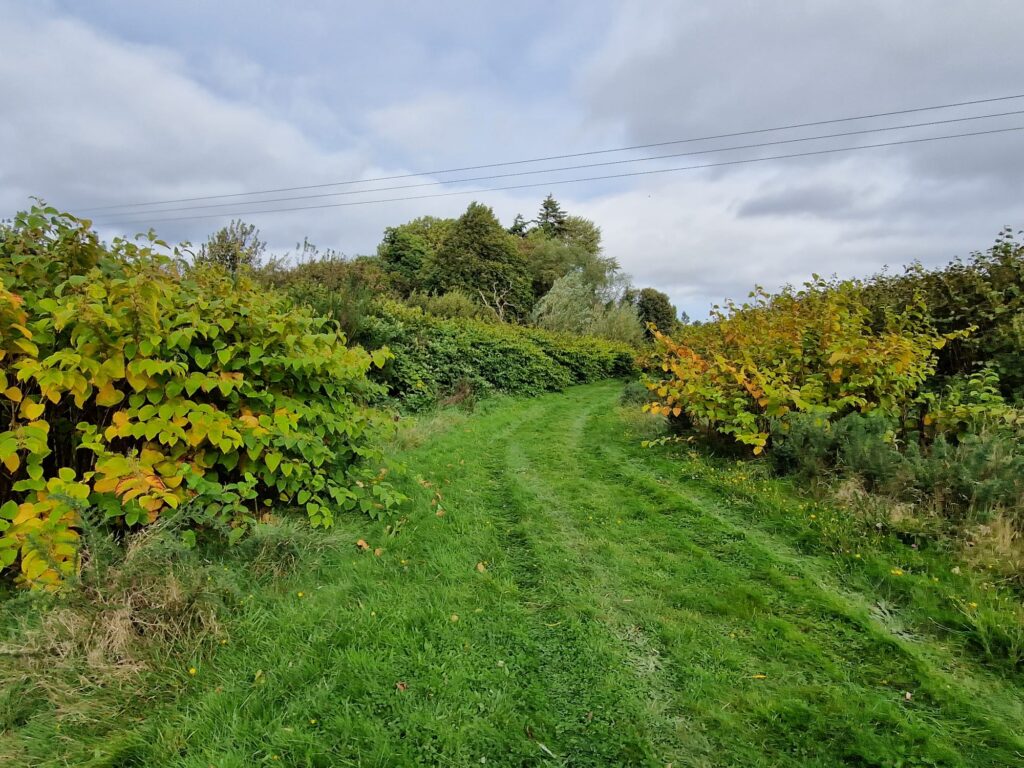
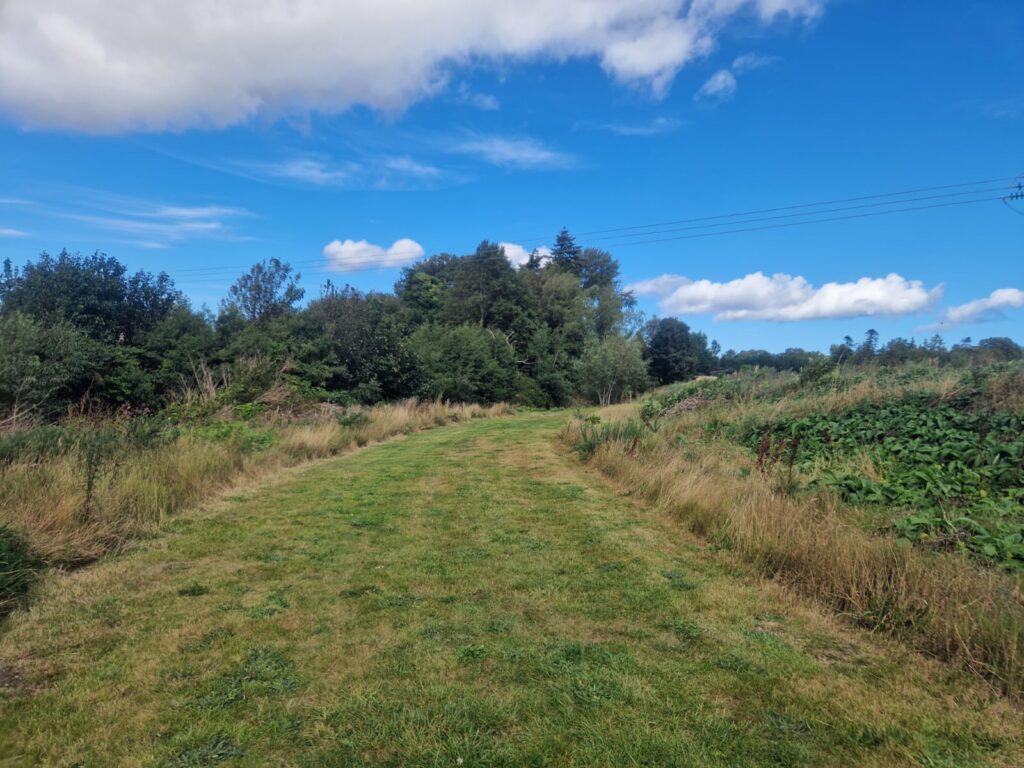
The abundance of Japanese knotweed was very high when the site was first identified in 2018. Prior to control in 2023, knotweed abundance was surveyed at three monitoring points and recorded as ‘dominant’, ‘abundant’ and ‘occasional’. Following initial treatment knotweed abundance reduced dramatically – first to ‘frequent’ at all monitoring points in 2024 and then to ‘occasional’ and ‘rare’ in 2025. It is no longer the dominant plant species on the site, with only minimal, patchy regrowth observed following the first treatment.
The abundance of invasive species was measured using the DAFOR scale* and is shown in Table 2 below. The change in abundance of Japanese knotweed at the site is shown in Figure 2.
Table 2 – Annual Japanese knotweed abundance from surveys (2023 – 2025) at Mayne Farm
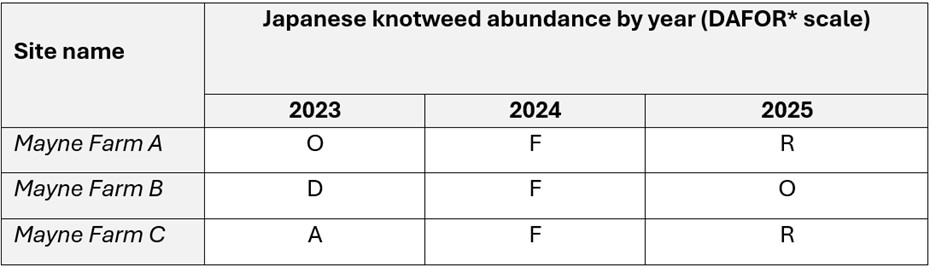
* – DAFOR Scale of abundance – D = Dominant (50 – 100% cover), A = Abundant (30 – 50% cover), F = Frequent (15 – 30% cover), O = Occasional (5 – 15 % cover), R = Rare (<5% cover), N = Not Present
Figures 2a and 2b – Japanese knotweed infestation at Mayne Farm on the River Lossie – October 2023 (left) and September 2025 (right). All photos taken prior to annual treatment.
4.2 Chemical usage
Glyphosate (Roundup ProVantage 480mg/l) was applied using the power sprayer and knapsack sprayer as a foliar spray at a concentration of 20ml per litre. The volume of glyphosate used per year is shown in Table 3 (below). The chemical volume required to treat the entire site was highest in 2023, the first year of treatment, at 8.5 litres. However, the chemical volume needed to treat the site decreased significantly to 0.9 litres in 2024 and to 0.4 litres in 2025.
Table 3 – Volume of glyphosate used to control Japanese knotweed (2023 – 2025) at Mayne Farm

4.3 People effort
Control work on the site was undertaken by a combination of Scottish Invasive Species Initiative and Findhorn, Nairn and Lossie Rivers Trust staff and volunteers and private landowners. Table 4 (below) shows the effort in terms of hours of control work spent on site each year.
The time needed to complete control on the site has substantially reduced from 35 hours in 2023, to 7.5 hours in 2024, and 4 hours in 2025. The hours needed for control were high in 2023, not only because of the extent of the infestation but also as more people were required to operate the power sprayer. As the power sprayer was no longer required to treat the site, control was undertaken by operators with knapsacks in subsequent years.
Table 4 – People hours used to control Japanese knotweed (2023 – 2025) at Mayne Farm

5. Conclusions and Progress Made
The ongoing treatment of Japanese knotweed at the Mayne Farm site on the River Lossie has made excellent progress in reducing target species abundance and with associated reductions in both time and chemical volume required for annual control.
Japanese knotweed had been dominant on the site since project records began in 2018. However, after control in 2023, Japanese knotweed abundance was reduced significantly following one year of treatment. Use of the power sprayer tank allowed the entire site to be treated in one season, where traditional control methods would have taken a number of years to treat the full extent of growth by pushing in from the edges of the dense stands. Remaining knotweed on the site is now controlled using knapsack sprayers and surveys of the plant in 2025 have recorded knotweed as ‘rare’ or ‘occasional’ – with abundance reduced at all three monitoring points.
Hours spent and chemical volume required for control reduced by 89% and 95% respectively between 2023 and 2025. Reductions in chemical and time in 2025 were less dramatic than those seen between 2023 and 2024, but this is expected as we will continue to see small amounts of regrowth at the site for a number of years.
In addition to the reduction of Japanese knotweed, the success of control works on the site has meant access to continue giant hogweed control has improved. Additionally, since control began, regeneration of native riparian plants has been observed in areas previously dominated by knotweed.
Progress on this site is encouraging, but it will be necessary to continue to treat regrowth to ensure the rhizome of the plant is completely exhausted. This work will proceed on an annual, and then biennial basis, until eradication is achieved.
6. Next Steps
Japanese knotweed abundance has been substantially reduced on the Mayne Farm site. In 2026, we will assess if the site should move to a biennial treatment plan or if annual control should continue for now. As the infestation is much improved, we will look to engage with all landowners to put in place a sustainable control plan going forward.
Further information
Contact: sisi@nature.scot