
Summary
The Dunkeld Bridge site on the River Tay was dominated by Japanese knotweed, part of a widespread infestation in the general area, causing problems for native biodiversity, public access, bank erosion and contributing to the further spread of the plant to downstream areas. Working with land managers and the local community, the Scottish Invasive Species Initiative began to treat the knotweed in 2019 and annual treatment has continued through to 2025. Responsibility for the site was handed over to the land manager in 2023 as part of a voluntary land manager control agreement.
The site was surveyed annually and the results of the surveys and annual control efforts indicate that the treatments have successfully and substantially reduced the abundance of knotweed. We believe we are close to eradication of Japanese knotweed on the site. Annual monitoring and any required follow up control work continues in order to prevent regrowth and re-establishment from any remaining rhizomes. This work has been undertaken by a mixture of project staff, volunteers and the land manager.
1. Site description
The Dunkeld Bridge site is in the middle section of the River Tay, on the opposite bank from Dunkeld. The site starts at the Braan confluence (GR NO 02301 42373) and extends downstream for 1.2km (GR NO 03443 42010).
The majority of the area is owned and managed by National Trust for Scotland (NTS), except for a small area at the bottom which has never had knotweed present. Within the Scottish Invasive Species Initiative partnership, the Tay catchment is covered by the Tay District Salmon Fishery Board (TDSFB).
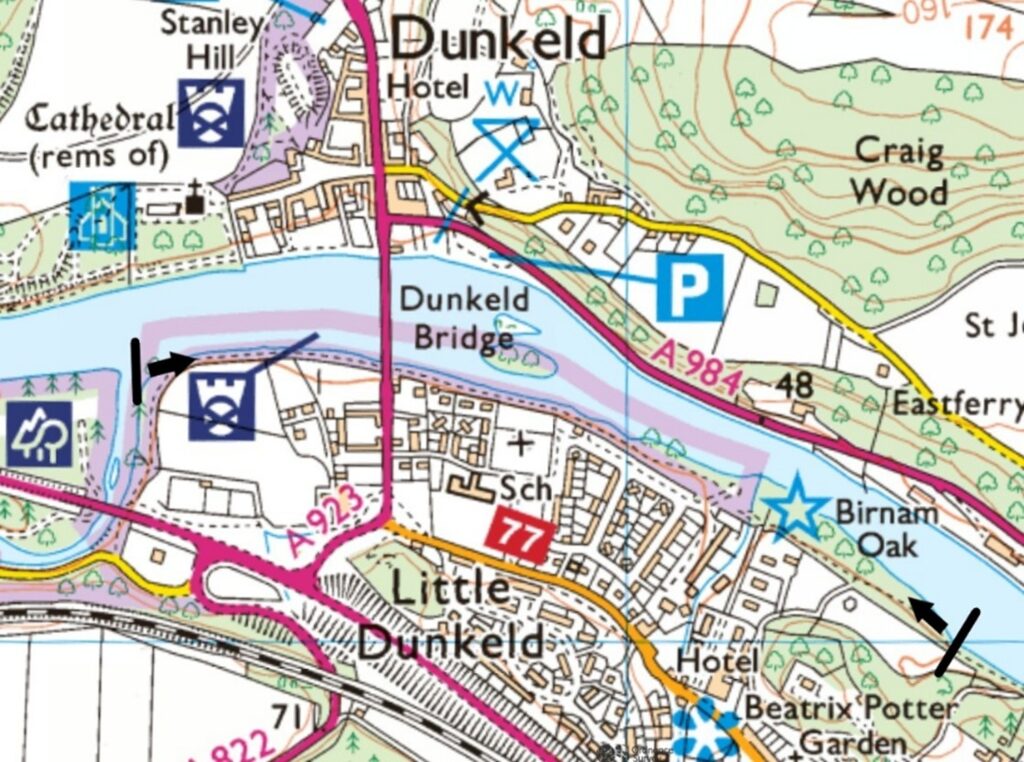
The bank consists of a strip of mature woodland, predominately sessile oak and alder, with some significant sized trees of biological and historical interest including the Birnam Oak. A well-used footpath runs the length of this bank.
The River Tay is designated a Special Area of Conservation (SAC) – primary feature being the Atlantic salmon with additional qualifying features of River lamprey, Brook lamprey, Sea lamprey and Otter.
2. Background
Japanese knotweed is widespread in the Tay system, and this section had become particularly badly infested to a point where it was dominant on both the left and right banks, to the detriment of native species. There was local enthusiasm from land managers and river users to tackle the problem in the Dunkeld area, including the Dunkeld Bridge site.
As well as the impacts on biodiversity, the knotweed was contributing to an erosion problem on the bank. During the winter, after the knotweed died back for the season, the sandy and loose soil was being steadily washed away as there was no native vegetation remaining on the bank. Although hard reinforcement works had been undertaken on the opposite (left) bank to prevent erosion, the knotweed rhizomes were also starting to shift some of the large boulders used for this and reducing their effectiveness.
The knotweed at the Dunkeld Bridge site was also observed to be suffering disturbance and damage – both from people taking access and from the local beaver population, causing broken and grazed stems to spread downstream from the site, exacerbating the problem in the general area.
The Scottish Invasive Species Initiative noted the scale of the knotweed problem during plant surveys in 2018 and approached the land manager (National Trust for Scotland) to discuss control options at the location. A co-ordinated control programme was agreed, with support from Dunkeld and Birnam Angling Association who lease the opposite (left) bank. The Initiative gave guidance and assistance with treatment, equipment and materials for control works, and provided places on training courses to enable NTS staff and a number of volunteers to gain necessary pesticide application qualifications.
3. Management works
The Japanese knotweed was treated for the first time in 2019 with Glyphosate applied by stem injection. That year the infestation was treated twice as growth was so dense, it was not possible to adequately inject the full extent of the infestation on the first attempt. An initial treatment was done, and a second visit was made about three weeks later to inject more stems after the first control had taken effect and areas had begun to die back. This double application in the first year delivered effective control and significantly weakened the rhizome.
Surveys in 2020 confirmed a massive reduction in density, with little or moderate regrowth recorded. As a result, the primary control method was changed to foliar spray from 2020 onwards. The infestation on the site was reduced so greatly that the site was handed back to NTS to undertake any future control. A control break was taken in 2023 to allow the small regrowth to become slightly larger so it could be treated more effectively in 2024 and 2025.
We have now advised NTS to move to a biennial control regime for the site.
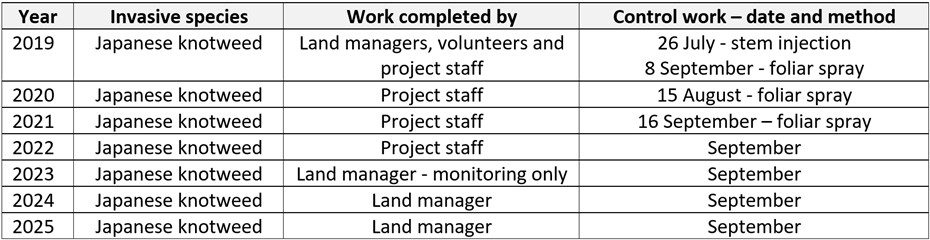
The Table 1 below shows a summary of the control treatments.
Table 1 – Summary of control treatments at the Dunkeld Bridge site (2019 – 2025)
4. Results
4.1 Invasive species abundance
Monitoring was carried out at two representative points within the site (referred to as points A and B in Table 2). When work began at Dunkeld Bridge in 2019, Japanese knotweed was recorded as ‘dominant’ and ‘frequent’ in abundance using the DAFOR scale (see Table 2) at these monitoring points.
The reduction in Japanese knotweed abundance after the initial treatments in 2019 was significant. The bank saw an approximate 90 – 95% reduction in knotweed infestation. There was a small amount of healthy regrowth in 2020, but primarily small patches of stressed regrowth of various size – suggesting that the rhizome had been severely compromised and had very little energy left to support meaningful regrowth.
Both monitoring points recorded Japanese knotweed abundance as ‘rare’ from 2020 onwards, with stressed regrowth becoming less frequent and smaller. In 2024 and 2025, Japanese knotweed was recorded as ‘not present’ at monitoring point B.
Survey results are shown in Table 2 below.
Table 2 – Annual Japanese knotweed abundance from surveys (2019 – 2021) at the Dunkeld Bridge Site

* – DAFOR Scale of abundance – D = Dominant (50 – 100% cover), A = Abundant (30 – 50% cover), F = Frequent (15 – 30% cover), O = Occasional (5 – 15 % cover), R = Rare (<5% cover), N = Not Present
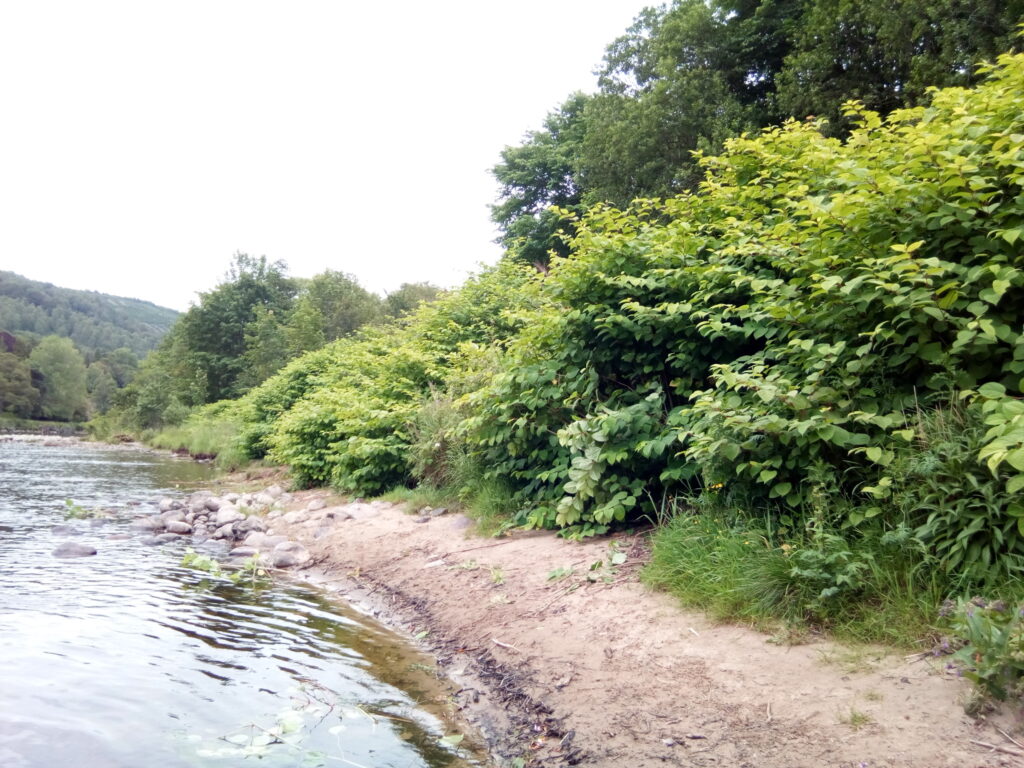
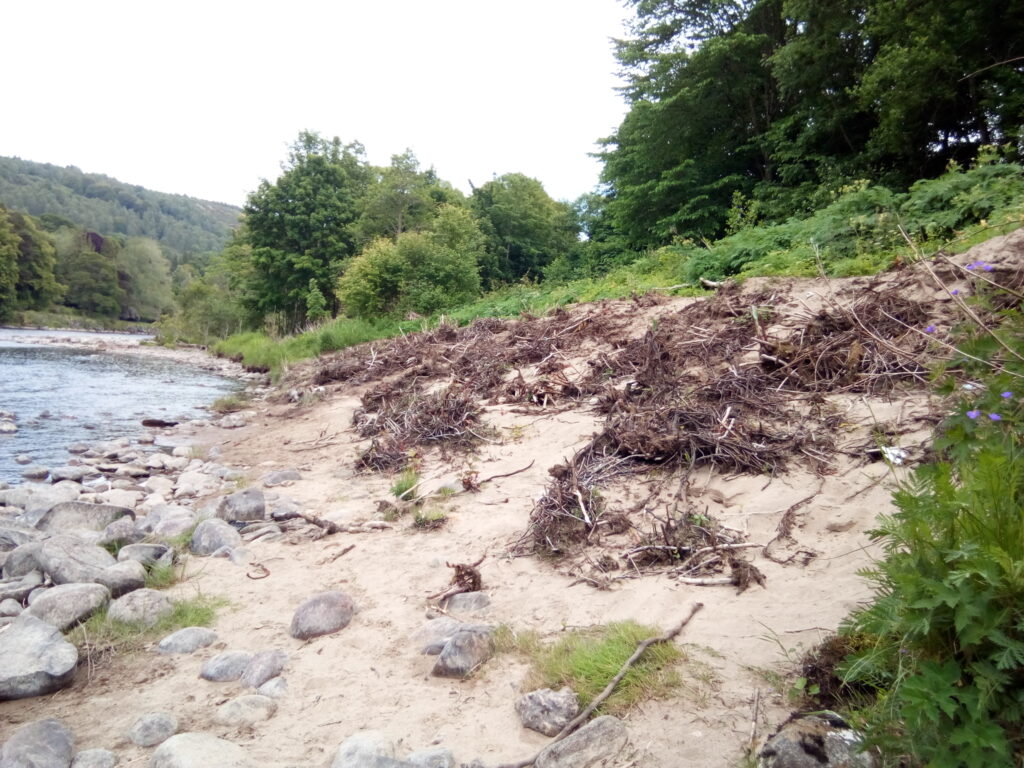
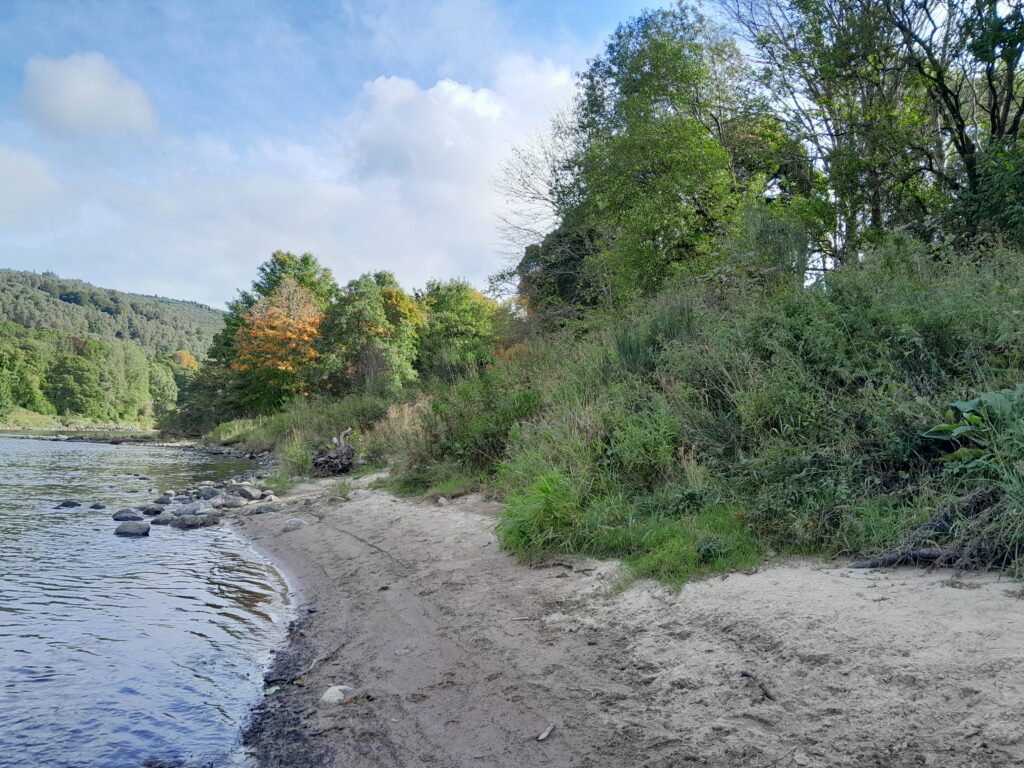
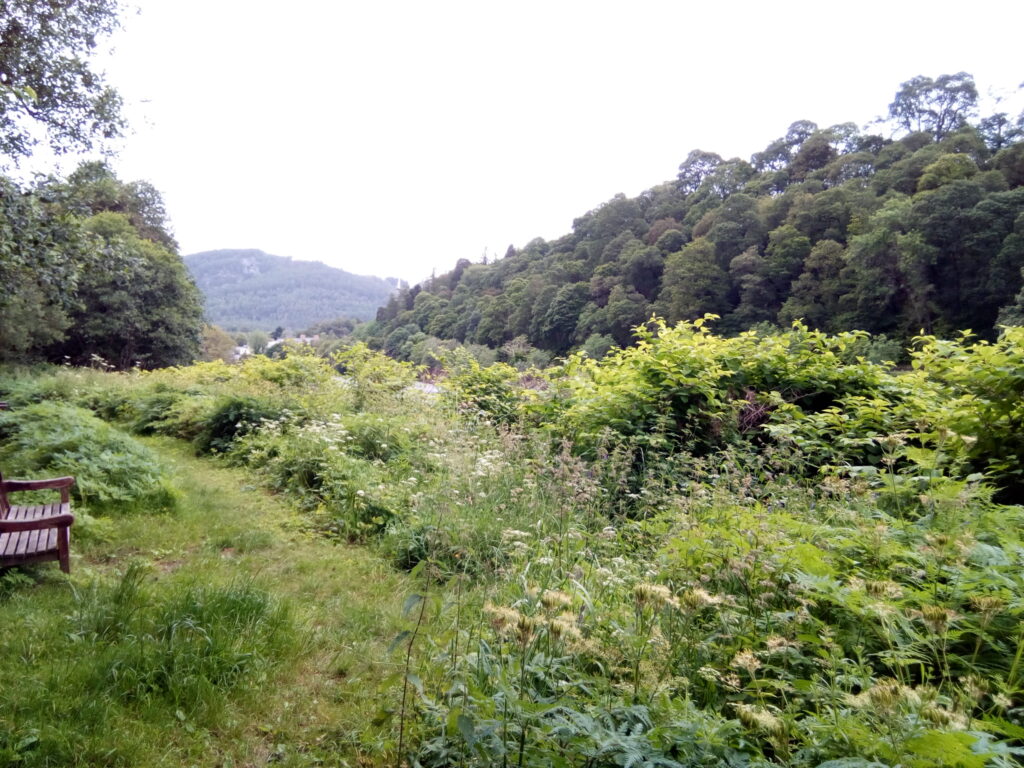
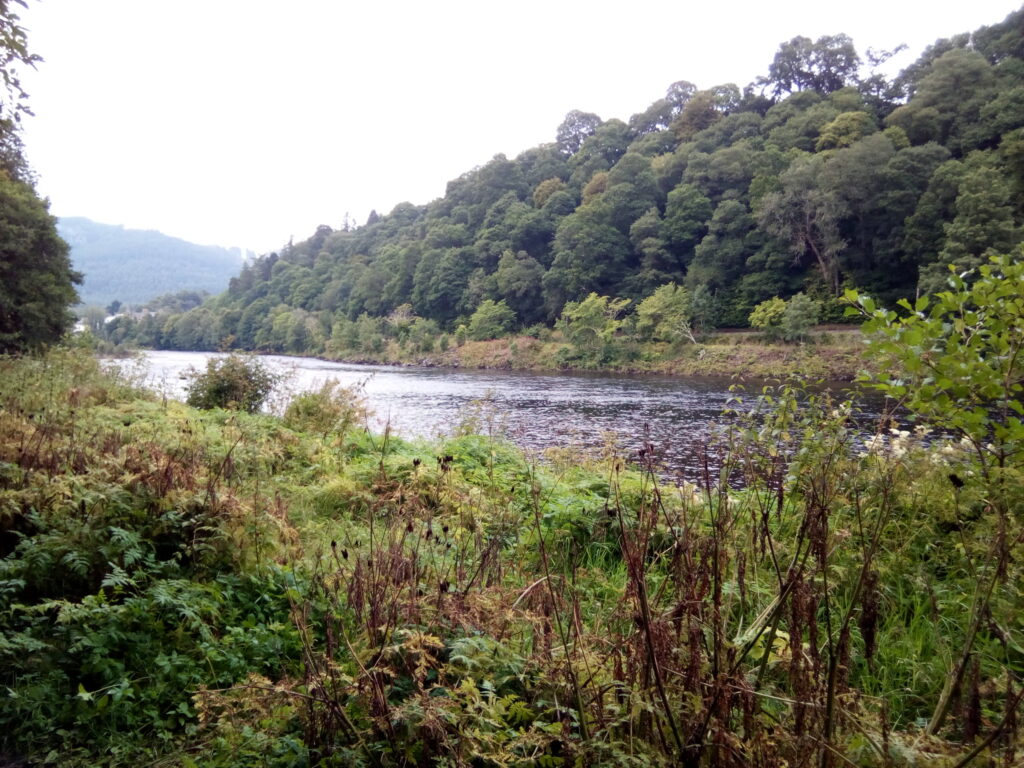
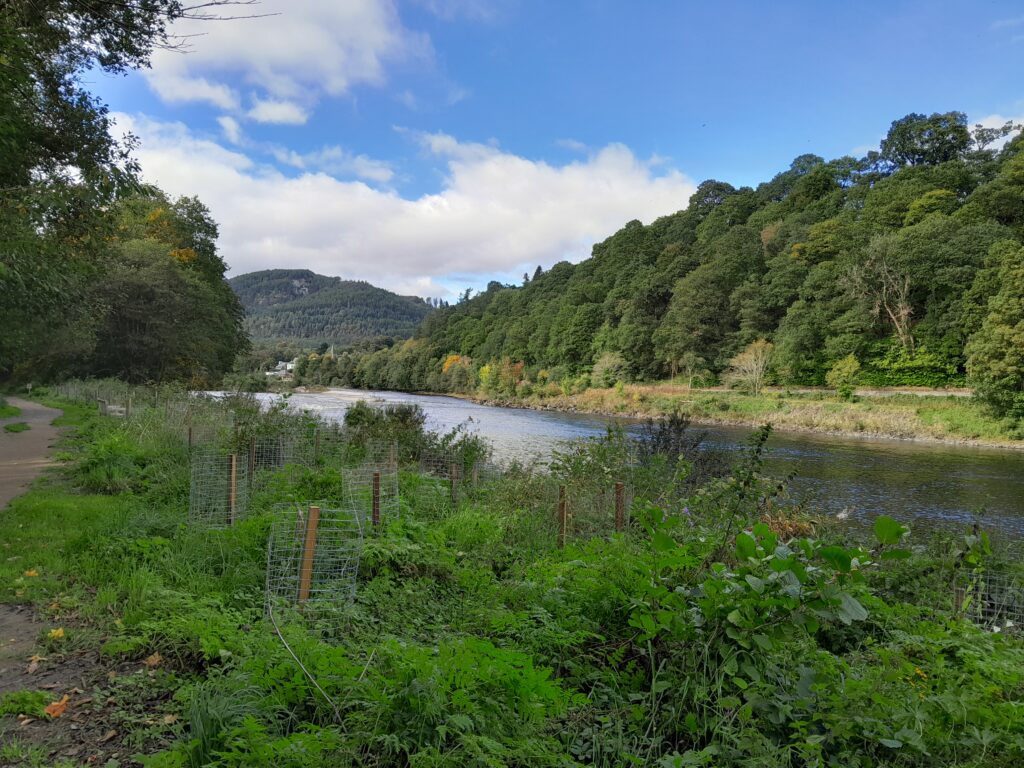
Images Before and After Control
4.2 Chemical usage
Glyphosate (‘Round-up ProVantage’) was applied either by stem injection – using a measured dose of 2ml per stem – or by backpack spraying at a concentration of 20-25ml per litre. Table 3 below shows the volume of pesticide applied at the site and confirms the large reduction in chemical dose required between 2019 and 2025 to undertake control.
Table 4 – Volume of glyphosate used to control Japanese knotweed (2019 – 2025) at the Dunkeld Bridge Site

4.3 People effort
A number of people worked with Scottish Invasive Species Initiative staff to bring this site under control. This included rangers employed by NTS, members of the Dunkeld and Birnam Angling Association and local community volunteers. Several people gained formal pesticide application qualifications through support from the Initiative.
In total, seven people helped with control works in 2019 and two in 2020. No additional help was required in 2021 as the site had improved to a point where project staff could easily sweep the site as part of other follow up work in the area. Project staff oversaw control in 2022 and responsibility for the site was handed back to NTS staff as part of a voluntary landowner control agreement for the 2023 season onwards. There was so little growth visible in 2023 that a control break was taken until larger growth could be identified and controlled in 2024.
Table 5 below shows the effort in terms of hours of control work spent on the site.
Table 5 – People hours used to control Japanese knotweed (2019 – 2025) at the Dunkeld Bridge Site

5. Conclusions and Progress Made
The initial control works undertaken in 2019 were highly effective.
The impacts of treatment were most dramatic in 2020, demonstrated both by on-the-ground observations (see Figures 1 (a-c) and 2 (a-c)) which found large reductions in the extent of Japanese knotweed observed on site and in the DAFOR scores, which recorded abundance reducing from ‘dominant’ to ‘rare’ after the first year of control.
As expected, there was some regrowth from knotweed rhizomes in 2020 and small, highly stressed regrowth in later years. This increasingly limited regrowth indicates that the remaining rhizomes have significantly depleted energy reserves and that control works have been successful. Remaining regrowth has continued to decline over the years and at some monitoring points Japanese knotweed is no longer present.
Chemical volume and hours spent on control have also reduced substantially, most dramatically from 2019 to 2020 where these decreased by 94% and 94% respectively. Hours spent on site has fluctuated since then – it is time consuming to search for small remnants of growth and in some years there was no treatment – but chemical volume has decreased by 98% from 2019 to 2025.
It is likely the site is now very close to eradication as the energy stores in final rhizomes are depleted. The Scottish Invasive Species Initiative has handed over ongoing management of the site back to NTS, who are implementing their own monitoring and control of any remaining regrowth.
The most positive indicator of improvement to the site is that native flora has re-establish along the river bank and is now dominating the site. NTS has also planted a number of trees on the site (see Figure 2c) to help improve bank stability.
6. Next Steps
As the site has now been handed back to the land manager, who will continue to monitor for and control any identified regrowth until eradication is achieved, there is no longer direct involvement on the site from the Scottish Invasive Species Initiative. Project staff continue to advise the land manager and to carry out annual surveys – from 2026 this will follow a biennial monitoring programme.
Further information
Contact: sisi@nature.scot