Summary
Newtyle beat is a 1.6km river section in the middle Tay, lying between Dunkeld (upstream) and Caputh (downstream). The section was infested with Himalayan knotweed which had reached the site from an ornamental garden upstream. Mechanical control was attempted there for a number of years, prior to the Scottish Invasive Species Initiative operating in the catchment, to try and deal with the problem – this was ineffective and spread the plant further, both within the site and downstream to new areas through the movement of plant fragments.
The problem was identified by the Initiative in 2018 when the project began work with the land manger (Newtyle Fishings) at the site. The first priority was to ensure mechanical control by strimming and mowing was ceased and control switched to pesticide application. Separately, the project initiated Himalayan knotweed control at the upstream ornamental garden to prevent further infestation from above.
The site has been surveyed annually and the results show a marked decline in abundance and control effort after the first year of control in 2019. These records indicate that management work have been successful and the site is now largely clear of Himalayan knotweed.
1. Site description
The Newtyle Beat is a popular angling location on the left bank of the main stem of the River Tay, a short distance downstream of Dunkeld and Birnam. The approximate mid-point of the site is at grid reference NO 04624 40535. Within the Scottish Invasive Species Initiative partnership, the Tay catchment is covered by the Tay District Salmon Fishery Board (TDSFB).
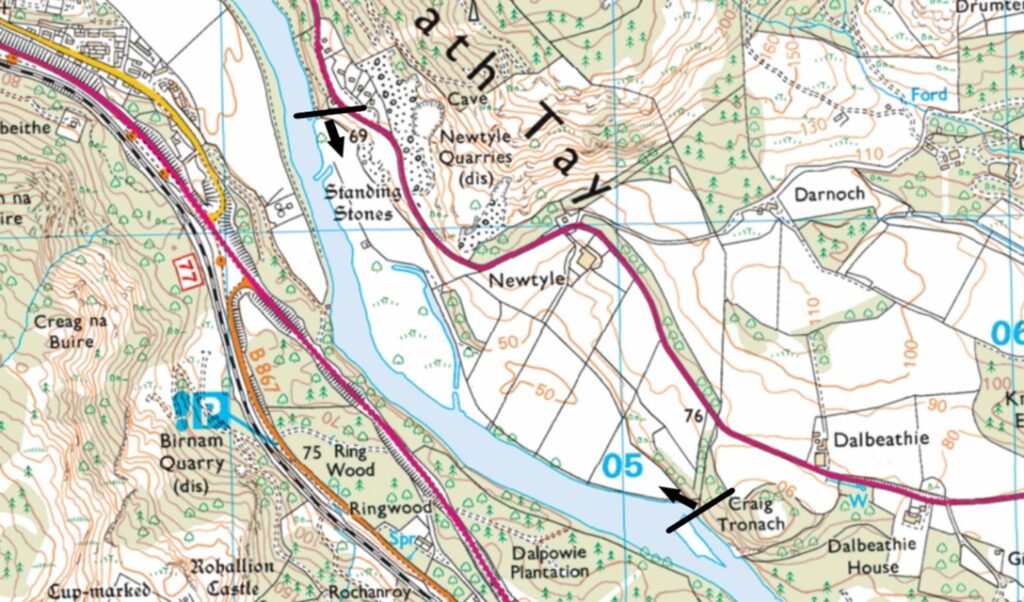
The site is a strip of grassland, wildflowers, shrubs and mature trees which runs along the outside edge of fields used for grazing. Deciduous trees cover the opposite bank.
The River Tay is designated a Special Area of Conservation (SAC) – primary feature being the Atlantic salmon with additional qualifying features of River lamprey, Brook lamprey, Sea lamprey and Otter.
Himalayan knotweed was the most abundant invasive non-native plant present at Newtyle. There are also small areas of Japanese knotweed on site, and Himalayan balsam in some areas too. The Himalayan knotweed grew in dense monoculture stands and dominated the bank, outcompeting native flora on the site. Due to its presence on the very edge of the riverbank it also caused significant bank erosion and restricted the use of the river by preventing riverbank access for angling and other activities.
2. Background
Himalayan knotweed initially arrived at Newtyle from plant fragments washed downstream from a population present in an ornamental garden, approximately 1km upstream. Mechanical control of Himalayan knotweed within the garden had been attempted, however, this generated large quantities of plant fragments which were washed downstream to Newtyle. These fragments were then able to regenerate and Himalayan knotweed established in dense stands at the site.
Despite not being the original source, Newtyle Beat became the primary source of Himalayan knotweed in the middle Tay due to the mechanical control attempted on site for a number of years, which continued to generate and spread plant fragments further on the beat and downstream. As a result, other downstream areas on the middle Tay, including sites in the Murthly, Caputh and Kinclaven areas, became infested.
The Scottish Invasive Species Initiative identified the scale of problem at the site in 2018 and approached the managers of Newtyle Fishings to discuss working in partnership to control the plant effectively. Mechanical control by strimming and mowing was ceased. The Initiative then supported the local ghillie to gain chemical application qualifications, supplied spraying equipment and herbicide, and advice to enable the appropriate pesticide application control to be undertaken.
3. Management works
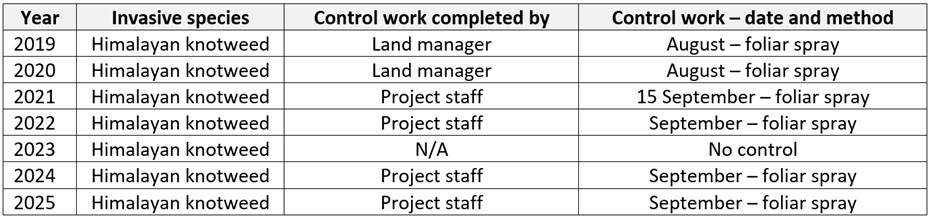
The Himalayan knotweed was treated for the first time in 2019 with control continued annually in following seasons. Glyphosate (Round-up ProVantage) was applied by foliar spray (spraying directly onto the leaves of the plant) by backpack sprayer with a single application made in each year.
Spaying was undertaken by the ghillie at Newtyle in years 2019 and 2020, with project staff completing follow up control in further years.
Table 1 below shows a summary of the control treatments.
Table 1 – Summary of control treatments
4. Results
4.1 Invasive species abundance
Monitoring was carried out at two representative points within the site (referred to as points A and B in Table 2). When work began at Newtyle in 2019, Himalayan knotweed was recorded as ‘dominant’ in abundance using the DAFOR scale (see Table 2) at both monitoring points.
After the first year of control in 2019, abundance reduced significantly as rhizomes were compromised and limited regrowth appeared in the following years. Both monitoring points recorded Himalayan knotweed abundance reduced to ‘rare’ from 2020 onwards, with no growth found at all in 2023, but small ‘rare’ regrowth reappearing in 2024 and 2025.
The abundance of invasive species was measured using the DAFOR scale and is shown in Table 2 below.
Table 2 – Annual Himalayan knotweed abundance from surveys (2019 – 2025) at Newtyle Beat

* – DAFOR Scale of abundance – D = Dominant (50 – 100% cover), A = Abundant (30 – 50% cover), F = Frequent (15 – 30% cover), O = Occasional (5 – 15 % cover), R = Rare (<5% cover), N = Not Present
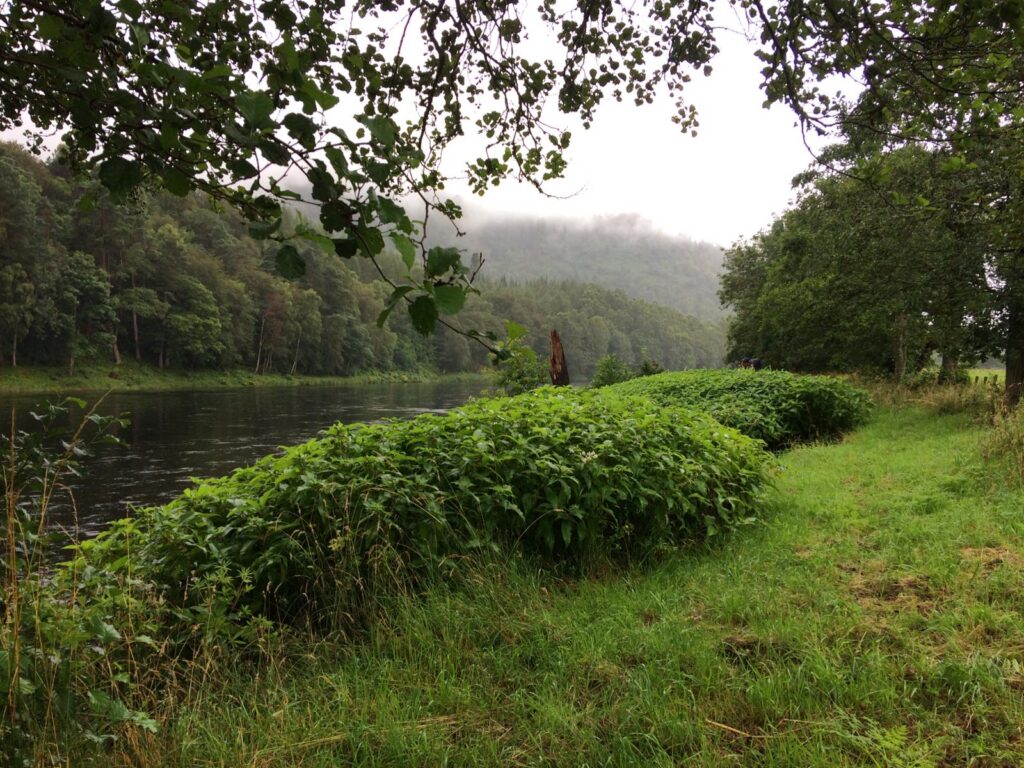
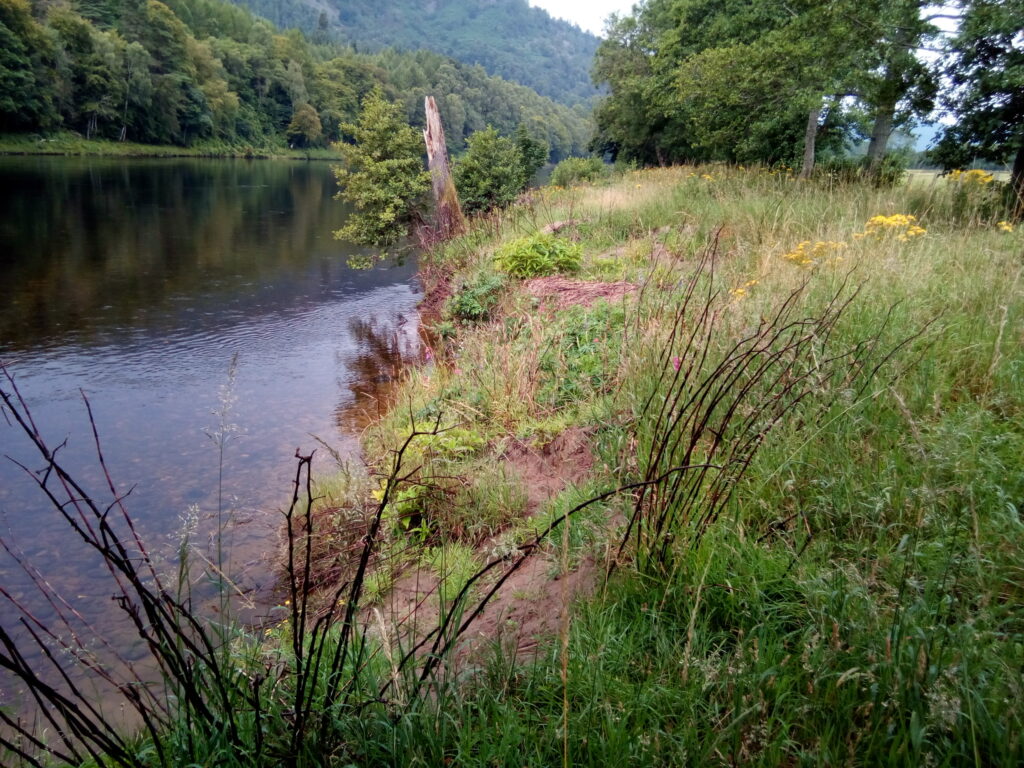
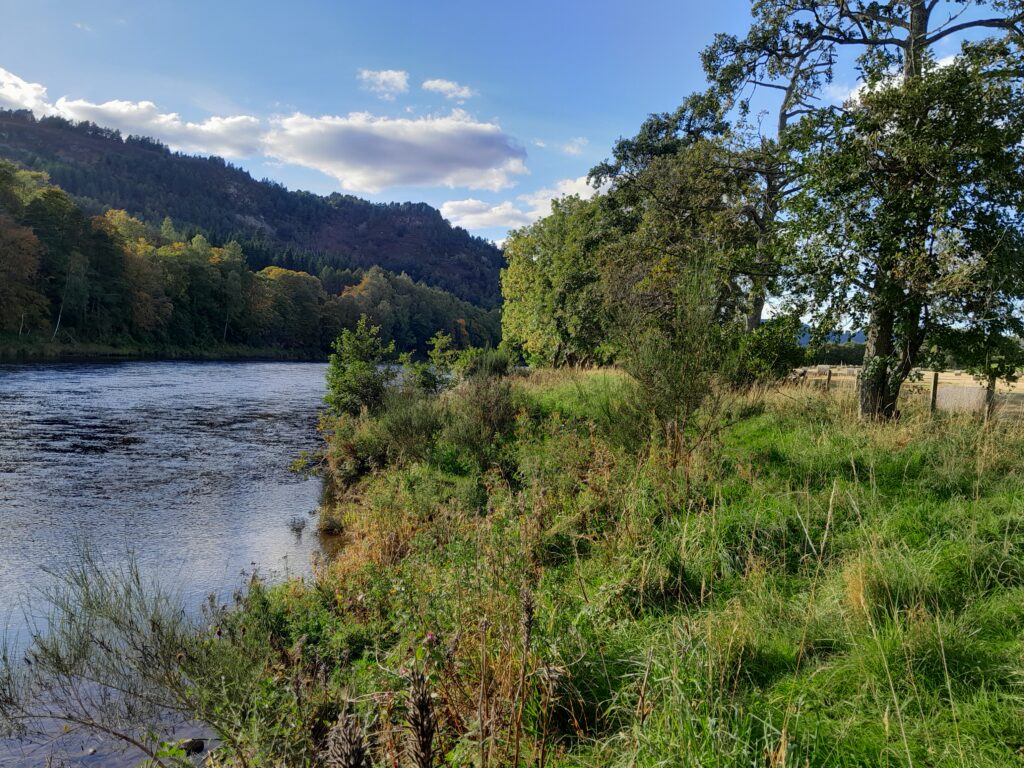
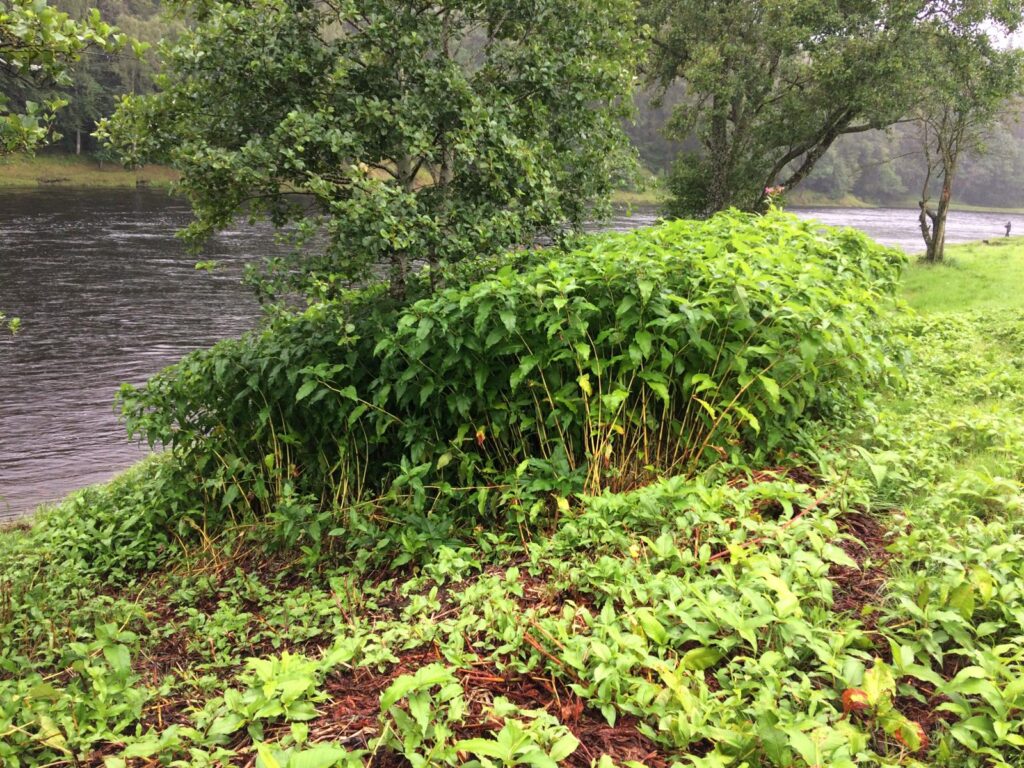
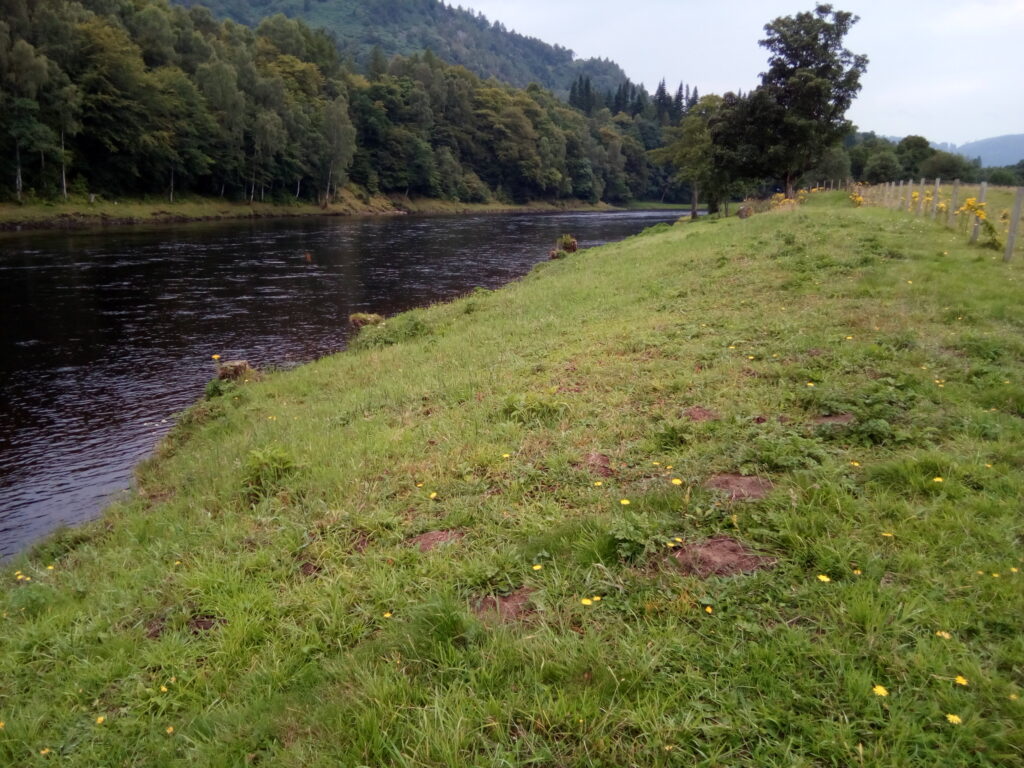
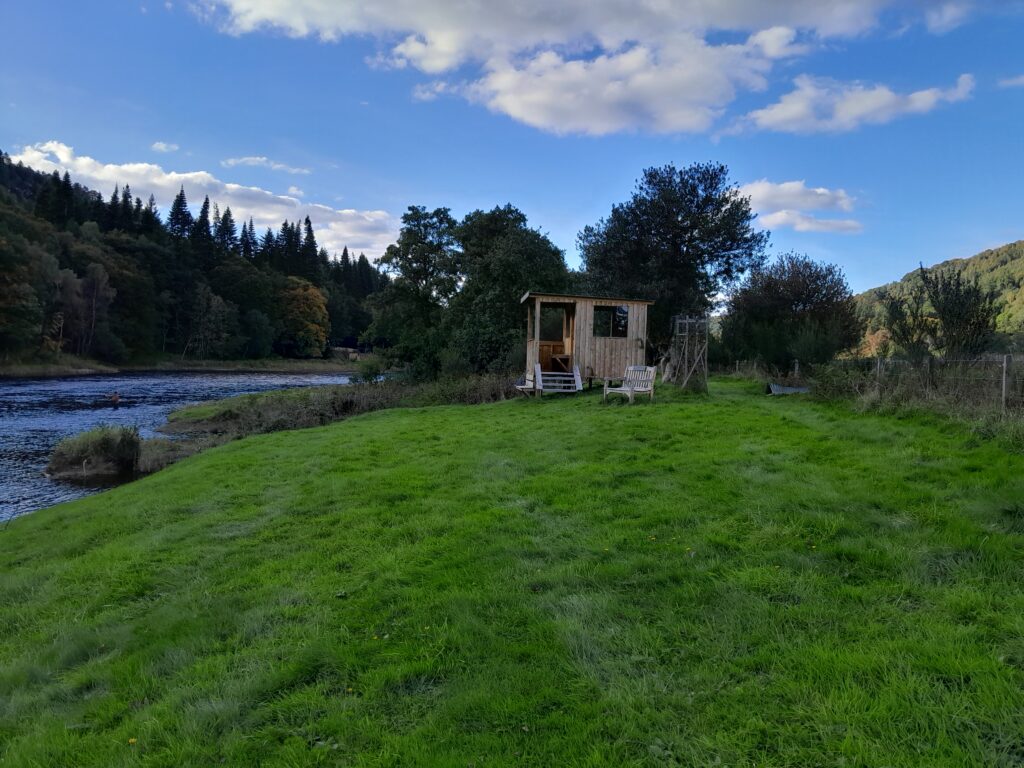
Images Before and After Control
4.2 Chemical usage
Each year, glyphosate was applied by backpack sprayer to deliver a foliar application at a concentration of 25ml per litre. This slightly higher dose rate (than the usual 20ml per litre application) was selected in recognition of the strong and vigorous growth of Himalayan knotweed at the site.
Table 3 – Volume of glyphosate used to control Himalayan knotweed (2019 – 2025) at Newtyle Beat

4.3 People effort
Control was undertaken in 2019 and 2020 by the ghillie at Newtyle who, following training funded by the Initiative, was qualified to do this himself. In 2021 the ghillie left his position at Newtyle and so control was delivered by Scottish Invasive Species Initiative staff – to ensure that the gains made from 2019-2020 control were not lost. The new ghillie was trained in survey techniques to ensure the monitoring and reporting of Himalayan knotweed presence to project staff was continued, but the decision was made not to provide pesticide training as annual follow up work was so minimal.
Table 4 (below) shows the effort in terms of hours of control work spent on the site.
Table 4 – People hours used to control Himalayan knotweed (2019 – 2025) at Newtyle Beat

5. Conclusions and Progress Made
The impacts of the Himalayan knotweed control work delivered at Newtyle Beat since 2019 are significant.
This is demonstrated by the observed change in abundance of the plant at the site (see Figures 1a-c and 2a-c) and in the DAFOR abundance scores at monitoring points which recorded abundance reducing from ‘dominant’ in 2019 to ‘rare’ in 2020 and in later years. So little growth was visible in 2023, that a control break was taken to allow any regrowth to become more obvious and practical to control. Years of mowing the dense areas of growth have spread tiny plant fragments all over the beat, so small areas of growth have occasionally appeared in previously untreated areas of the beat.
Whilst in 2019 a relatively high control effort was required at the site, this reduced substantially in 2020 and in following seasons, with a reduction of 85% in the control hours required to treat the infestation (2019-2025). Similarly, the volume of pesticide applied reduced by 92% over the same period.
The site has been brought into an improved state where monitoring and any required annual control can be completed in a very manageable hour-long visit to the site. Regrowth was so minimal in 2023 that treatment was not feasible, so a control break was taken. A biennial control program will be implemented in 2026 until all regrowth is removed from site. Importantly, control of the Himalayan knotweed source at the upstream ornamental garden site is also in place – this will prevent-re-infestation from above and make the objective to eradicate Himalayan knotweed at Newtyle Beat achievable.
The Newtyle Beat case shows both how the problems caused by incorrect treatment of invasive plants can be made worse – in this case this through the mowing and stimming of Himalayan knotweed – and also that the situation can be improved reasonably quickly once correct methods are used.
Support from the Scottish Invasive Species Initiative through advice provided to the land manager and funding the training for staff was instrumental in bringing about successful control at the site. Control was primarily achieved by one employee deploying the correct control methods.
6. Next Steps
Previous mechanical control at the site (which distributed plant fragments widely) means that Himalayan knotweed regrowth persists at Newtyle – albeit the extent of this growth is much reduced. However, now that the Himalayan knotweed growth at the site has been brought into a manageable state, close to complete eradication, it can be controlled with a minimal allocation of time and resources. The new ghillie and project staff will survey for any regrowth on a biennial basis and then undertake any required control.
Further information
Contact: sisi@nature.scot
Download this case study as a PDF
Additional Images
Figures 2a, b and c show the extent of Himalayan knotweed growth at the sites before and after treatment. Abundance reduced significantly following one year of control delivered in 2019.