
Summary
The Muckle Burn drains into Findhorn Bay in Moray. Giant hogweed has been well established on the burn for many years with only limited attempts to control it. In June 2018, the Scottish Invasive Initiative identified a site on the Muckle Burn as a priority for control. This was in an area upstream of control locations existing at that time. The site, at the Old Mill in the village of Brodie, was sizeable, established and in full flower. Giant hogweed control started at the site in 2019 and has continued annually through to 2025.
Since annual control began in 2019, the abundance of giant hogweed has been reduced and it is no longer the dominant plant on the site. In conjunction with this, the effort and chemical volume required to deliver control has significantly reduced over the years since the site was first identified and treatment began.
Annual monitoring and control was undertaken by the Scottish Invasive Species Initiative in 2025 and will be required for a number of years beyond this. Even after seven years of control there is a diminished seedbank remaining at the site which will take a number of years to completely exhaust. By preventing plant maturation, seed setting and dispersal, the seed bank will be progressively diminished, and the infestation further reduced.
Now that the site has improved considerably and ongoing control works will be more manageable, we intend to initiate discussions about ongoing responsibility for the site with relevant land managers and owners.
1. Site description
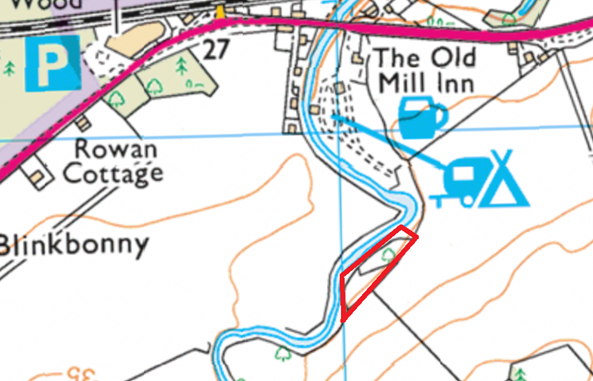
The Old Mill site is situated on the Muckle Burn to the south of the A96, at the village of Brodie in Moray (grid reference NH 980 567). The control area, located on the right bank of the burn and accessed via the nearby caravan park, extends to about 0.6 ha and is 150m long by 40m wide, with a steep bank on the southern boundary. The site is owned by Darnaway Estate. The site location is shown in Map 1.
Previously thought to be the uppermost infestation on the Muckle Burn, further stands have since been discovered upstream and are now being controlled.
Within the Scottish Invasive Species Initiative, the Muckle Burn catchment is covered by the Findhorn, Nairn and Lossie Rivers Trust.
The Muckle Burn flows into Findhorn Bay, a large tidal bay also fed by the River Findhorn, the Mosset Burn and the Kinloss Burn. The bay is popular with tourists and water sport enthusiasts and the presence of giant hogweed poses a risk to members of the public. Findhorn Bay is a Local Nature Reserve and is part of the Moray and Nairn Coast Special Protection Area – designated due to its waterfowl assemblage and individual qualifying species list of bar-tailed godwit, dunlin, greylag goose, osprey, oystercatcher, pink-footed goose, red-breasted merganser, redshank and wigeon.
Due to the tidal nature and current patterns in Findhorn Bay, giant hogweed infestations in any river that drains into it – such as the Muckle Burn – are likely to spread seed and plant materials widely, thereby supporting the establishment of new areas of growth around the shores of the bay.
2. Background
Giant hogweed has been present on the Muckle Burn for many years and is well established in numerous locations. A coordinated programme of control has been delivered by the Findhorn, Nairn and Lossie Rivers Trust to tackle the plant in the catchment – this has both restricted further spread and reduced the scale of the problem in many locations. Limited control was carried out on the Muckle Burn and some landowners were controlling giant hogweed further downstream.
The Old Mill site in the village of Brodie was identified as a priority site in June 2018 – this was located upstream of control sites active at that time. Additional assessment of the Muckle Burn above the A96 identified several more, smaller giant hogweed stands further upstream. Therefore, it was essential to put in place control at the Old Mill – as the largest infestation – and at these smaller sites upstream, to prevent them acting as seed sources for downstream locations.
As the plant density at Old Mill was exceptionally high when identified in 2018, control in 2019 was scheduled early in the season to ensure safe access to the site before the plants grew so large as to make control dangerous.
3. Management works
The giant hogweed at Old Mill was first treated by the Scottish Invasive Species Initiative on 16April 2019 – much earlier in the season than spraying would normally begin due to the density of the growth anticipated at the site. This allowed safe access throughout the season as the hogweed would not grow to a large size after early initial control. Remaining flower heads were removed by manual cutting, prior to them setting seed, in June 2019.
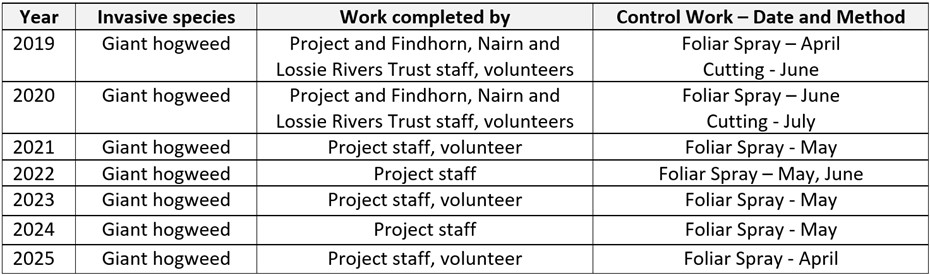
Since 2019 glyphosate (Round-up ProVantage) has been applied by foliar spray (spraying directly onto the leaves of the plant) by backpack sprayer with a single application delivered most years – two rounds of treatment were required in 2022. Flowering heads were also cut in 2019 and 2020 but this has not been required since, as no plants reached this stage of maturity at the site.
Table 1 below shows a summary of the control treatments.
Table 1 – Summary of control treatments (2019 – 2025) at Old Mill, Muckle Burn, Brodie
4. Results
4.1 Invasive species abundance
The abundance of giant hogweed at the Old Mill site was very high when the site was identified in 2018. Giant hogweed growth was dominant and dense across many parts of the site. Initial treatment of the infestation took place in 2019 and annual control has taken place since then. Prior to treatment each year, the site was scored using the DAFOR scale* – these records are shown in Table 2 (below). From 2018 to 2022, giant hogweed abundance at the Old Mill was recorded as ‘dominant’. Since then, abundance has been reduced – first to ‘abundant’ in 2023 and then to ‘occasional’ in 2024 and 2025. It is no longer the dominant plant species on the site and instead now only occurs in sparse, isolated patches.
This change in abundance of giant hogweed at the site is shown in Figures 1-3.
Table 2 – Pre-treatment giant hogweed abundance at Old Mill, Muckle Burn, Brodie (2018 – 2025)

* – DAFOR Scale of abundance – D = Dominant (50 – 100% cover), A = Abundant (30 – 50% cover), F = Frequent (15 – 30% cover), O = Occasional (5 – 15 % cover), R = Rare (<5% cover)
Images Before and After Control
Figures 1a & 1b – Giant hogweed stand at Old Mill on the Muckle Burn – April 2019.
Pre-treatment in 2019 – survey photos were taken early in the season, ahead of treatment, with second- and third-year growth already visible. Multiple dead stems and flower heads are present from mature plants flowering and setting seed in 2018.
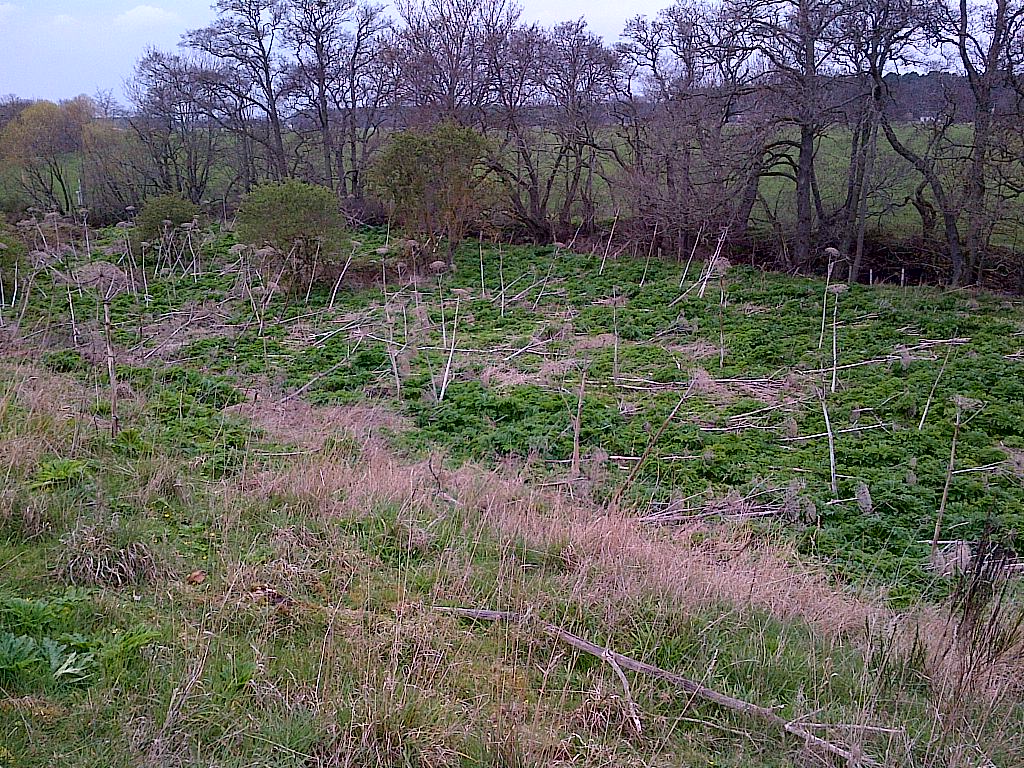
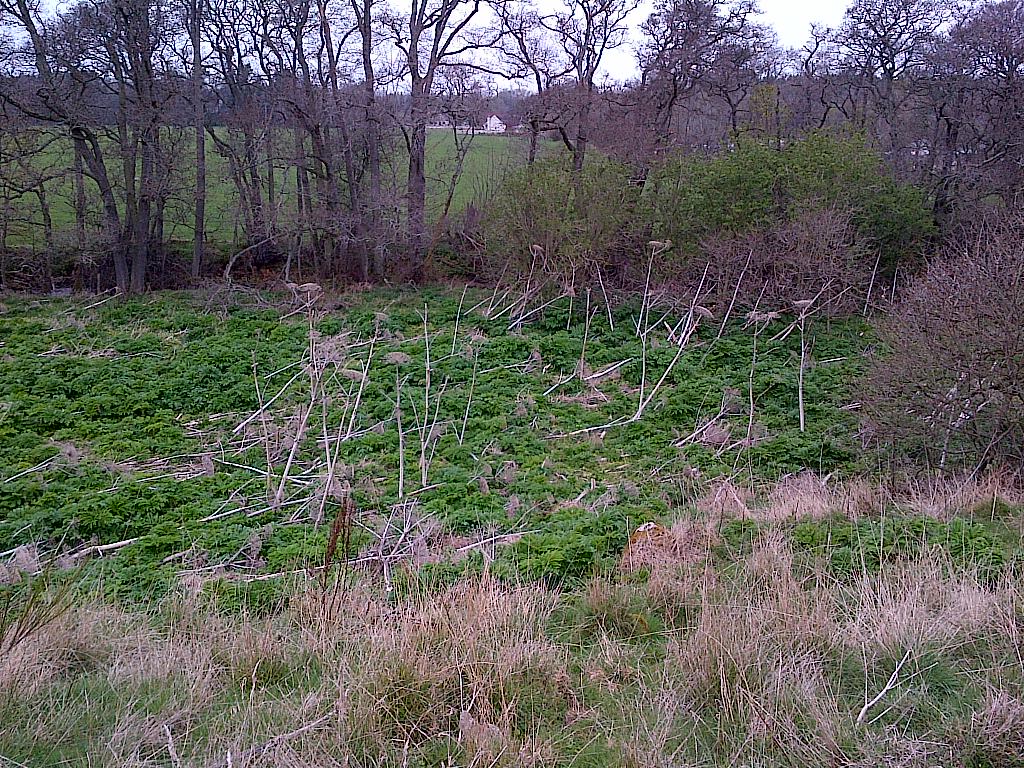
Figure 2a & 2b – Giant hogweed stand at Old Mill on Muckle Burn – May 2021.
Pre-treatment in 2021 – giant hogweed is still dominant but the site is now covered by immature plants. No flower heads are visible from the 2020 season, indicating seed dispersal did not take place that year.
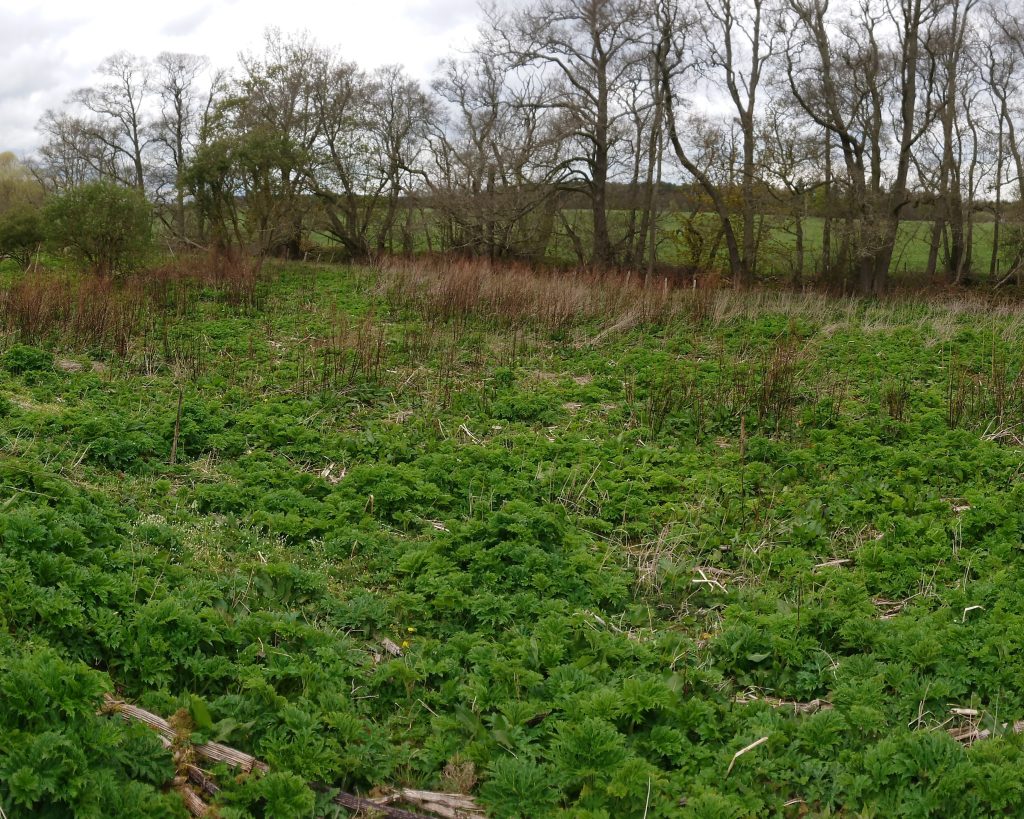
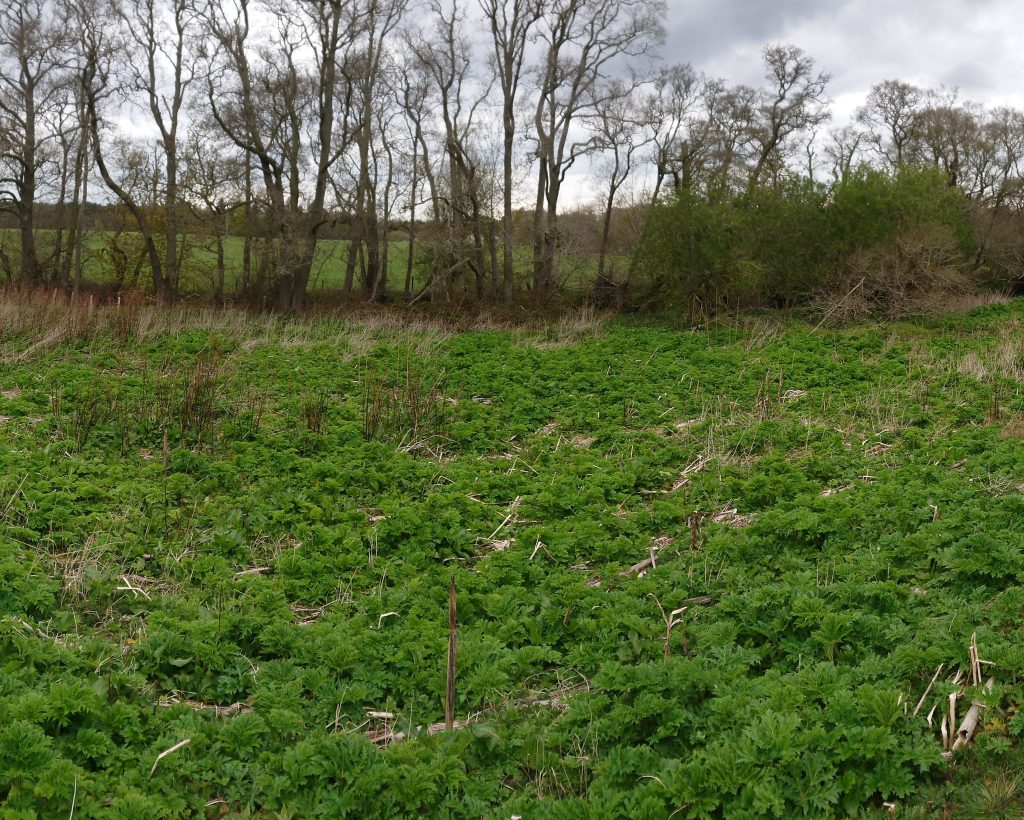
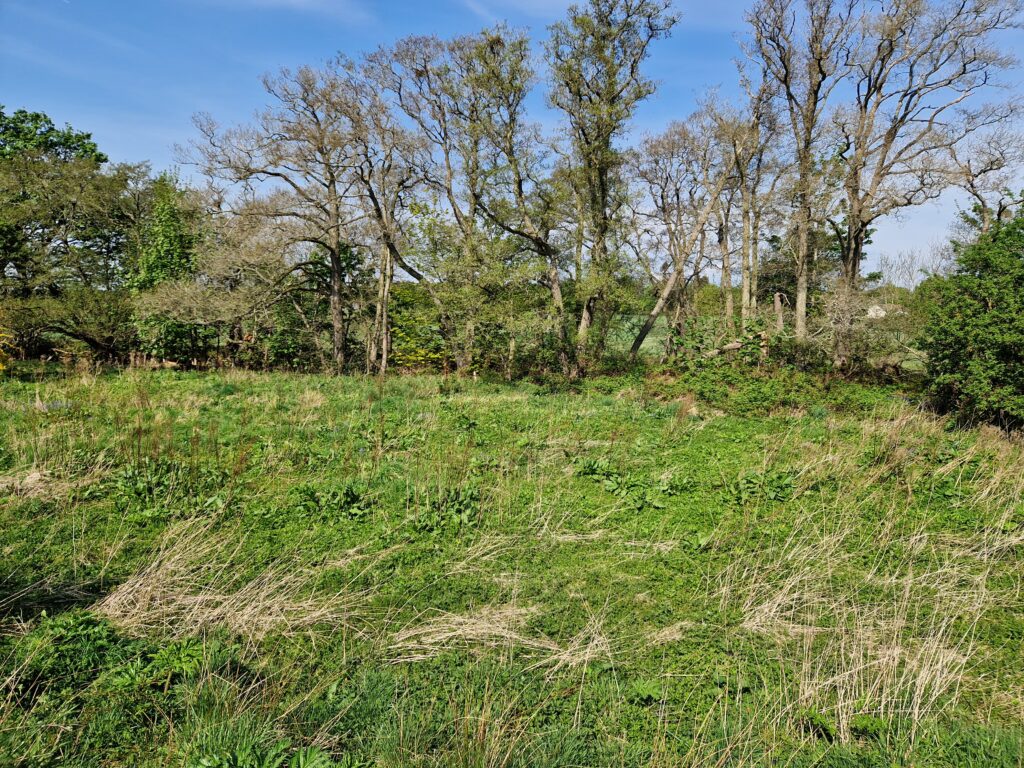
Figure 3a & 3b – Giant hogweed stand at Old Mill on Muckle Burn – May 2025
Pre-treatment in 2025 – no mature plants are present, giant hogweed abundance has been reduced and the plant now only occurs in sparse patches.

4.2 Chemical usage
Glyphosate (Roundup ProVantage 480mg/l) was applied by backpack sprayer as a foliar spray at a concentration of 20ml per litre. The volume of glyphosate used per year is shown in Table 3 (below). The chemical volume required for treatment has decreased steadily over the years, from 5.2L in the first year of treatment (2019) to only 0.2L in 2025.
Table 3 – Volume of glyphosate to control giant hogweed (2019 – 2025) at Old Mill, Muckle Burn, Brodie

4.3 People effort
Control work was undertaken by a combination of Scottish Invasive Species Initiative and Findhorn, Nairn and Lossie Rivers Trust staff and volunteers. Table 4 (below) shows the effort in terms of hours of control work spent on site each year. The time required to deliver control has reduced significantly since the first year of treatment, from 20 hours in 2019 to only 4 hours in 2025. The significant increase in time allocation in 2023 was due to the annual site visit being used to train a new member of staff. Control hours have otherwise varied slightly over the years but remained relatively low compared to the first year of treatment.
Table 4 – People hours used to control Giant hogweed (2019 – 2025) at Old Mill, Muckle Burn, Brodie

5. Conclusions and Progress Made
The ongoing treatment of giant hogweed at Old Mill on the Muckle Burn has made good progress in terms of the overall abundance of the plant, as well as the time and chemical volumes required for annual control.
In the first few years of treatment (2019 – 2022) giant hogweed abundance continued to be recorded as ‘dominant’ at the site. As the initial infestation was substantial and severe, with dense stands of mature plants flowering and setting seed on an annual basis, there was a significant seedbank in the soil which took a few years to deplete. However, the age classes of the plants changed rapidly, with flower heads removed from mature plants in 2019 and 2020 – no flowering plants have been found since then. By 2021, the majority of plants were immature, and therefore unable to flower or set seed, and very few mature plants were present. These early signs of progress were encouraging while giant hogweed abundance remained high.
In 2022 the situation remained the same but from 2023 we began to see further progress, with giant hogweed recorded as ‘abundant’ in 2023 and ‘occasional’ in 2024 and 2025. Now that mature plants are no longer able to set seed, the continuing annual control of immature plants will reduce and eventually remove the infestation over time. The time and chemical volume required for control has reduced from 2019 (when control was initiated) to 2025 (see Tables 3 and 4). Hours spent and chemical volume required for control reduced by 80% and 96% respectively over this period.
This is encouraging progress. Ongoing annual control will be required at the Old Mill site for a number of years to further reduce abundance of giant hogweed. The plant has been well established at the site for a significant period and, following many years of successful flowering and seed dispersal prior to treatment, a seed bank will still be present in the soil. As seeds remain viable for many years, consistent annual control will be required to make further progress and fully exhaust the seedbank.
6. Next Steps
Giant hogweed seedlings will continue to emerge at Old Mill in 2026 and beyond due to the persistent seed bank in the soil.
Treatment will be required on an annual basis to prevent these plants maturing and setting seed at Old Mill – and potentially infesting areas downstream. This will, in time, reduce the seed bank and the site will move towards being clear of giant hogweed. However, this will still take a number of years to achieve and will therefore require annual monitoring and control.
As the time and chemical volume required for annual control at Old Mill has been significantly reduced, and ongoing treatment is now a more manageable task, we intend to initiate discussions with the land manager to encourage their involvement in ongoing management and, in time, handover responsibility for the site.
Further information
Contact: sisi@nature.scot